Toyota Sequoia Towing Capacity: What Every Owner Should Know
# Toyota Sequoia Towing Capacity: What Every Owner Should Know
The Toyota Sequoia can tow up to 9,000 pounds on paper, but the number that actually matters for RV owners is **payload**—and that’s where most people get into trouble. The factory tow rating assumes a bare truck with one 150‑pound driver and nothing else. Load up your family, gear, and a travel trailer, and you’ll hit your payload limit long before you hit that 9,000‑pound number. Here’s how to figure out what your specific Sequoia can really pull.
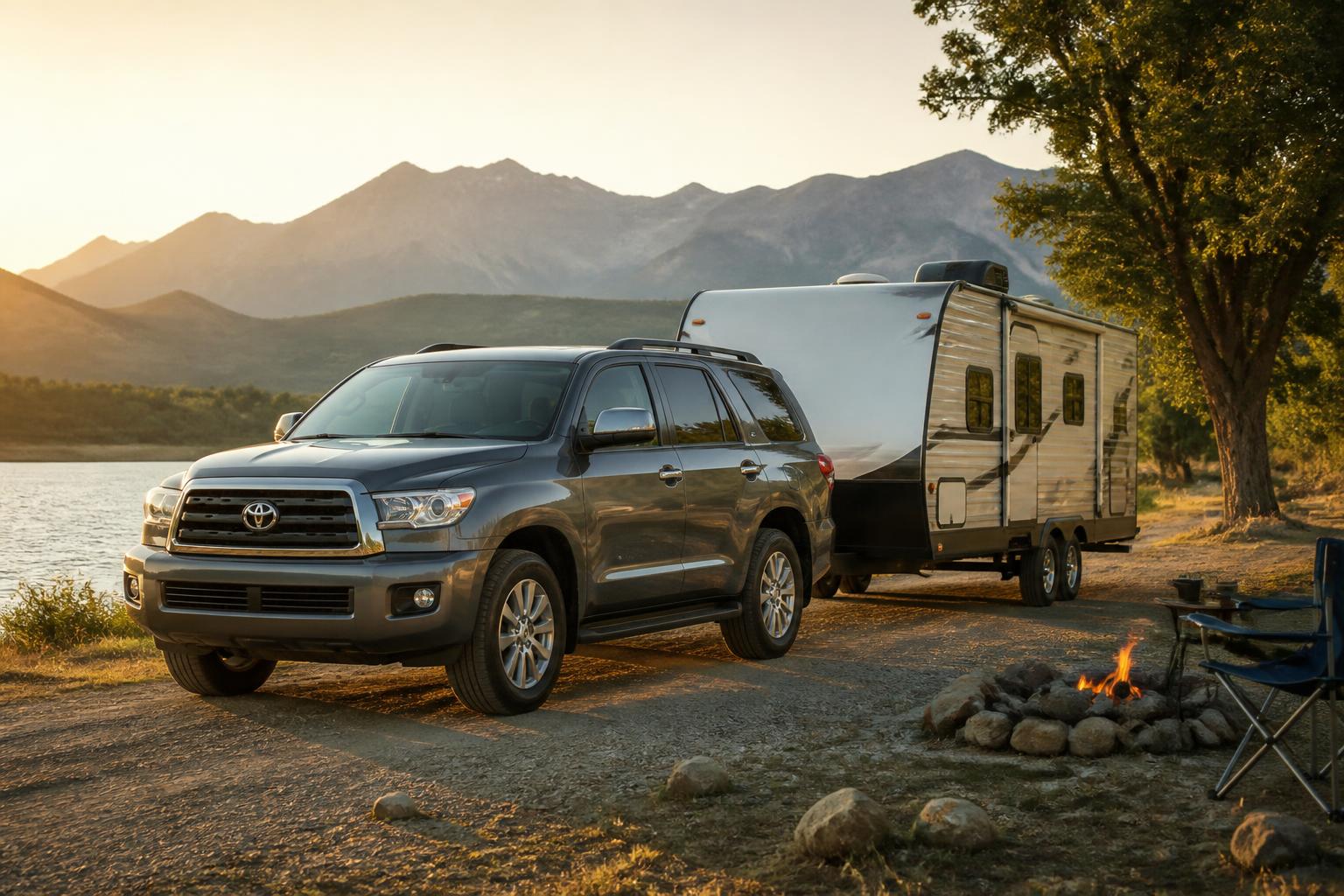
## Quick answer
– **2023–present (V6 hybrid, all trims):** Up to 9,000 lbs max tow, but payload runs 1,300–1,600 lbs depending on trim. Higher trims like Capstone and Platinum lose payload due to heavier seats, panoramic roof, and extra sound deadening.
– **2008–2022 (5.7L V8):** 7,000–7,400 lbs max tow with the factory tow package; drops to 5,000 lbs without it. Payload is roughly 1,200–1,400 lbs.
– **2001–2007 (4.7L V8):** 6,200–6,500 lbs max tow. Payload runs 1,100–1,300 lbs.
” really means for your Sequoia](https://rvownerhelp.com/wp-content/uploads/2026/05/toyota-sequoia-towing-capacity-step-2.jpg)
**The real‑world ceiling:** Even with a 2023 model rated for 9,000 lbs, you’ll be safe with trailers only up to about 7,200–7,500 lbs once you account for your actual passengers, cargo, and tongue weight.
## What “towing capacity” really means for your Sequoia
The max tow number is a **theoretical** limit. It assumes a perfectly loaded truck with exactly one 150‑pound driver and no extra gear, no dogs, no tools, and no hitch weight. In the real world, every person, every bag, and every pound of tongue weight eats into your payload—and payload is almost always the binding constraint for a Sequoia.
**Payload** = GVWR (Gross Vehicle Weight Rating, found on the driver’s door jamb sticker) minus the truck’s curb weight. Your specific Sequoia’s payload depends on trim level, factory options (sunroof, running boards, tow package, audio upgrades), and dealer‑installed accessories. Two identical‑looking Sequoias can differ by 200 pounds or more of payload.

Here’s the counter‑intuitive part most articles skip: **A higher trim level often means less towing capability in practice.** A 2024 Sequoia Capstone with all options might show 9,000 lbs max tow, but with only 1,300 lbs of payload, you’ll be forced into a lighter trailer than someone driving a base SR5 with 1,600 lbs of payload.
**Example walk‑through:** A 2023 Sequoia SR5 with 1,600 lbs of payload. Four passengers (600 lbs), a dog (80 lbs), and a weight distribution hitch (50 lbs) leave 870 lbs for tongue weight. At 12% tongue weight (typical for a travel trailer), your trailer can’t exceed 7,250 lbs GVWR—well under the 9,000 lb max. That’s a 25–28 foot travel trailer at most.
## How to calculate your safe towing setup (step‑by‑step)
This operator flow takes about 15 minutes with a scale and your owner’s manual. Run through these steps before you buy a trailer or hit the road.
### Step 1: Find your actual payload
Open the driver’s door and look for the yellow Tire and Loading Information label. Find “Combined weight of occupants and cargo should never exceed XXXX lbs.” Write that number down. *That* is your starting budget.
**Don’t trust brochure numbers.** The payload on Toyota’s website is an average at best. Your specific truck’s sticker is the only number that matters.
### Step 2: Weigh the truck as you’ll drive it
The most accurate method: go to a CAT scale with the Sequoia loaded as it would be on a trip (full fuel, all passengers, all cargo, hitch installed). Weigh the truck without the trailer. Subtract the scale reading from your GVWR—that remaining amount is what’s left for tongue weight.
If you can’t get to a scale, use a worst‑case estimate:
– Driver and passengers: 185 lbs each average
– Cargo in the cabin and cargo area: itemize it
– Weight distribution hitch: 50–70 lbs
– Trailer tongue weight: assume 13% of the trailer’s GVWR as a starting estimate
### Step 3: Apply the 80% safety rule
RV trailers gain weight as you load them with water, propane, gear, and food. A trailer’s “dry weight” from the brochure is essentially meaningless—the actual GVWR is what matters. The industry standard for a safe margin is **80% of your max tow rating**.
| Sequoia generation | Factory max tow | 80% safe max trailer GVWR |
|—|—|—|
| 2023+ (9,000 lb rated) | 9,000 lbs | **7,200 lbs** |
| 2008–2022 with tow package | 7,000–7,400 lbs | **5,600–5,900 lbs** |
| 2001–2007 | 6,200–6,500 lbs | **5,000–5,200 lbs** |
### Step 4: Choose the right hitch equipment
– **Weight distribution hitch (WDH):** Required for any trailer over 5,000 lbs. It spreads tongue weight across the truck’s front axle, improving steering, braking, and stability. Do not tow a 7,000‑lb travel trailer without one.
– **Trailer brake controller:** Needed for trailers over 1,500 lbs. Sequoias with the factory tow package include a pre‑wired connector under the dash, but you need to install a controller (Curt, Redarc, or OEM are popular). Adjust the gain during a slow, straight test drive—aim for smooth, matched braking where the trailer doesn’t lock up or push the truck.
### Step 5: Set tire pressures and mirrors
– Inflate rear tires to the maximum cold pressure listed on the sidewall when towing near rated capacity.
– Use extended towing mirrors if your Sequoia doesn’t have factory tow mirrors. For 2023+ models, the available digital camera mirror system works well. For pre‑2022 models, clip‑on or replacement mirrors are easy to install.
## Verification step: How to confirm your setup is safe before a trip
After everything is hooked up and loaded, go back to a CAT scale. Follow this two‑weigh process:
1. **Weigh the truck alone** (drop the trailer) — record the weight.
2. **Weigh the truck and trailer together** — record the combined weight.
**What success looks like:**
– Truck’s gross weight (with trailer attached) is **under the GVWR** shown on the door jamb sticker.
– Rear axle weight is **under the GAWR** (Gross Axle Weight Rating) listed on the same sticker.
– Tongue weight (truck weight with trailer minus truck weight alone) is between **10% and 15% of the loaded trailer weight**.
If any of these checks fail, you need to reduce cargo, move weight from behind the rear axle, or step down to a smaller trailer.
## Realistic failure mode: What goes wrong most often
The most common mistake Sequoia owners make is **trusting the trailer’s dry weight from the dealer**. A 2024 Jayco Jay Flight SLX 267BHS might list a dry weight of 5,800 lbs, but once you add two propane tanks, a battery, fresh water (40 gallons = 334 lbs), camping gear, food, and clothes, you’re easily at 7,000 lbs or more. That pushes tongue weight to 840+ lbs, which blows through the remaining payload on all but the lightest‑loaded Sequoias.
**Symptom:** The truck squats noticeably in the rear, steering feels light, and the trailer sways in crosswinds or when passed by semis.
**Likely cause:** You’re over payload. The weight distribution hitch can help, but it cannot fix a fundamentally overloaded truck.
**Safer next move:** Find a scale and check your actual weights. If rear axle weight exceeds GAWR, you must reduce load—not just “tighten the hitch.” If you’re consistently over, you need a heavier tow vehicle like a Tundra or a diesel 3/4‑ton.
## Stop/escalate threshold: When to say “this isn’t working”
If any of these conditions are true, stop your current setup and do not drive:
– **Rear axle weight exceeds GAWR** by any amount. This risks tire failure, brake fade, and loss of steering control.
– **Tongue weight is under 10% or over 15%** of the loaded trailer weight. Under 10% causes dangerous sway; over 15% overloads the truck’s rear axle.
– **The truck squats more than 1.5 inches at the rear bumper** after connecting the trailer with a weight distribution hitch adjusted correctly.
– **You’re using a standard hitch (no WDH) for a trailer over 5,000 lbs.** Stop and install a weight distribution hitch before moving.
– **The trailer’s GVWR exceeds 80% of your Sequoia’s max tow rating.** Seek a lighter trailer or a different tow vehicle.
When to escalate to a professional: If you’ve adjusted the weight distribution hitch, reduced cargo, and still can’t get within the limits above, visit a certified RV service center or a truck scale operator who can provide a printout and specific recommendations. Some RV dealers offer free weight checks for customers.
## Key facts and trim‑specific numbers
| Model Year | Engine | Max Tow (lbs) | Typical Payload (lbs) | 80% Safe Trailer GVWR |
|————|——–|—————|———————-|———————-|
| 2023–2025 | V6 Hybrid (i‑FORCE MAX) | 9,000 | 1,300–1,600 | 7,200 |
| 2008–2022 | 5.7L V8 (with tow pkg) | 7,400 (2WD) / 7,000 (4WD) | 1,200–1,400 | 5,600–5,900 |
| 2008–2022 | 5.7L V8 (no tow pkg) | 5,000 | 1,200–1,400 | 4,000 |
| 2001–2007 | 4.7L V8 | 6,500 (2WD) / 6,200 (4WD) | 1,100–1,300 | 5,000–5,200 |
**Important nuance for 2023+ owners:** The hybrid powertrain is the same across all trims, so max tow is uniform—but payload varies significantly. A Capstone with panoramic roof, ventilated seats, and premium audio can have 300 lbs less payload than a base SR5. Always check your specific door jamb sticker.
**For 2008–2022 owners:** The factory tow package includes an oil cooler, transmission cooler, and heavier‑duty radiator. Without it, the Sequoia is rated for only 5,000 lbs. Aftermarket coolers do not restore the factory rating—you can overheat on long grades.
## Decision aid: Can your Sequoia tow this trailer?
Run through these five checks before you buy or hook up:
1. **Trailer GVWR ≤ 80% of Sequoia’s max tow rating?**
☐ Yes ☐ No
2. **Estimated tongue weight (12–15% of loaded trailer GVWR) ≤ remaining payload after passengers and cargo?**
☐ Yes ☐ No
3. **Sequoia equipped with factory tow package or aftermarket rated for the trailer weight?**
☐ Yes ☐ No
4. **Weight distribution hitch and brake controller installed, adjusted, and tested?**
☐ Yes ☐ No
5. **Loaded truck weight (with trailer attached) verified under GVWR and GAWR on a scale?**
☐ Yes ☐ No
If any check is “No,” either reduce the trailer size or step up to a heavier‑duty tow vehicle. The Sequoia is a capable tow rig within its limits, but it’s not a heavy‑duty truck—pushing past those limits is unsafe and illegal in many states.
## Related questions
**Can a Toyota Sequoia tow a fifth wheel trailer?**
No. The Sequoia uses a unibody platform with independent rear suspension and a short wheelbase. It is not designed to accept a fifth wheel hitch. Stick to conventional travel trailers or boats.
**Does the Sequoia need a weight distribution hitch for a small trailer?**
For trailers under 3,500 lbs, a standard hitch with a ball mount usually works fine. For trailers between 3,500 and 5,000 lbs, a weight distribution hitch is strongly recommended to keep the truck level and improve stability. For any trailer over 5,000 lbs, a weight distribution hitch is required for safe handling.
**Where do I find the actual payload rating for my Sequoia?**
Look at the yellow Tire and Loading Information sticker on the driver’s side door jamb. It lists the combined weight of occupants and cargo that the vehicle is designed to carry. That number is your payload budget—do not rely on online specs or brochures.
**What is the towing capacity of a 2024 Toyota Sequoia without the tow package?**
The 2024 Sequoia comes standard with a towing receiver, but the maximum rating still requires the factory tow package (which includes the engine oil cooler, transmission cooler, and wiring harness). Without the package, Toyota recommends staying under 5,000 lbs to avoid transmission overheating on grades. Check your window sticker or VIN with a dealer to confirm.
## Explore This Topic
– Back to [Towing & Setup](/towing-setup-hub/)
Related guides in this cluster:
– [F150 Tow Capacity: What Every Owner Should Know](/f150-tow-capacity/)
– [The Complete Guide to F150 Towing capacity](/f150-towing-capacity/)
– [Understanding F 150 Towing Capacity: A Practical Guide](/f-150-towing-capacity/)
– [Ford Ranger Towing Capacity: A Complete Overview](/ford-ranger-towing-capacity/)

Practical RV guides from an experienced owner. Motorhomes, travel trailers, truck campers — we have owned them, maintained them, and written the guides we wish we had found when we started.