Popup Camper: Everything You Need to Know
A popup camper (also called a folding camping trailer or tent trailer) is a collapsible towable RV that folds down for travel and pops up into a canvas-and-hardwall shelter at camp. Its defining feature is the lift-up roof and fold-out tent sections that create standing room and sleeping space. That design makes a popup the lightest, most towable, and most affordable RV type you can buy—but also the one with the most compromises in insulation, security, and setup effort.
This guide walks through what actually matters when shopping: weight and tow limits, real usable space, ownership costs, and the trade-offs that make a popup either a perfect fit or a mistake for your camping style.

What a Popup Camper Does—and Doesn’t Do Well
A popup camper gives you a bed off the ground, a basic kitchen, and some weather protection at a fraction of the cost of a hard-sided travel trailer. Models range from tiny two-person boxes with just a dinette and bunk to full-size units with slide-out dinettes, three-way refrigerators, and indoor shower stalls.
The catch: everything that makes it light and affordable also makes it less durable, less weatherproof, and more labor-intensive than a conventional travel trailer. Canvas walls provide little insulation, the lift mechanism can fail, and setting up in rain or wind is genuinely unpleasant.
When a popup makes sense:
- Your tow vehicle has a 1,500–3,500 lb towing capacity (most midsize SUVs and minivans).
- You camp mostly in mild weather and rarely below freezing.
- Storage space at home is limited—a popup folds to about 5 ft tall and fits in a garage.
When a popup probably won’t work:
- You need four-season capability or camp in areas with heavy snow, extreme heat, or persistent humidity.
- You want to spend less than 15 minutes setting up or breaking down camp.

- You’re towing with a car that has a 1,000 lb max tow rating—even the lightest popups exceed that when loaded.
Sizing, Weight, and Tow Vehicle Requirements
Popups are measured by box length—the length of the closed trailer body—which ranges from about 8 ft to 16 ft. Open, the total length (including folded-out tent ends) can double.
Typical specs:
- Box length: 8–12 ft (most common), 14–16 ft (heavy-duty models with slide-outs)
- Dry weight: 1,200–2,500 lb for standard models; high-wall or slide-out models can hit 3,500 lb
- GVWR (gross vehicle weight rating): typically 2,000–4,000 lb
- Cargo capacity: 300–600 lb (hull weight + gear + water + propane)
- Sleeping capacity: 4–8 people, though realistic comfort for adults maxes out at 4–5
- Tongue weight: 150–350 lb (loaded)
Tow vehicle minimum standards:
Your tow vehicle’s rated towing capacity must exceed the camper’s GVWR, not its dry weight. A rule of thumb: if the camper’s GVWR is 3,000 lb, your vehicle should be rated to tow at least 3,500–4,000 lb to leave a safety margin for hills, heat, and brakes.
A common mistake is assuming a 2,500-lb dry weight means the camper will weigh that on the road. With propane tanks, a battery, water, food, and gear, add 300–600 lb. That loaded weight is what matters for your hitch, transmission, and brakes.

BLOCKQUOTE_0
Concrete verification step: Before buying any popup, measure your garage door opening height and the camper’s closed height (given in the manufacturer’s specs). Most garages have 7-ft doors, but a high-wall popup can be 58 in. (4 ft 10 in.) tall, which still leaves clearance. However, low garages with a 6-ft door will block many standard popups around 52 in. Run the tape before making an offer. Same for driveway length—a 16-ft box plus tongue adds another 4–5 ft of overall towed length.
Popup vs. Teardrop vs. Small Travel Trailer
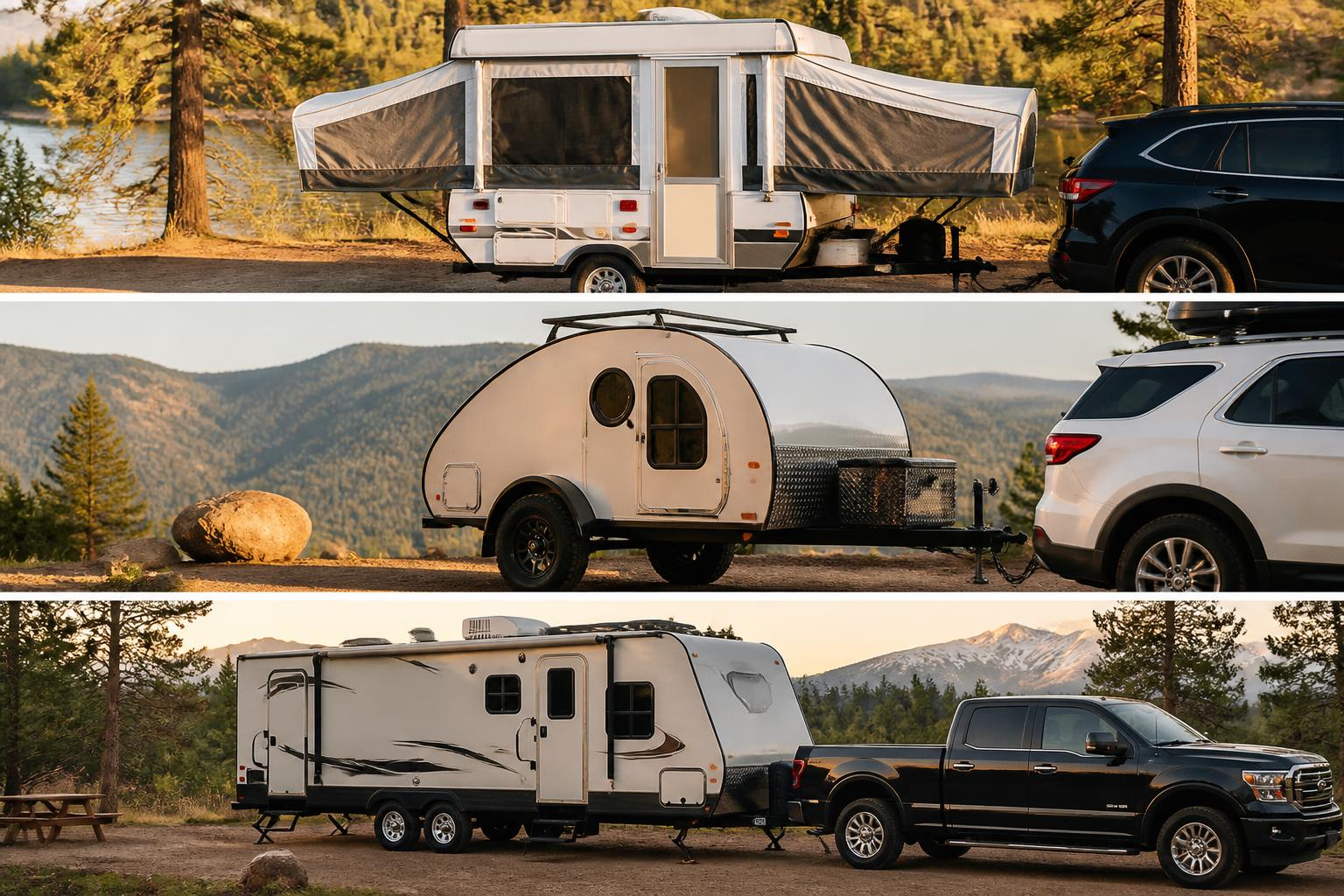
The closest competitors to a popup camper are teardrop trailers and small (14–18 ft) lightweight travel trailers. Here’s how they differ:
| Aspect | Popup Camper | Teardrop Trailer | Small Travel Trailer (16 ft) |
|---|---|---|---|
| <strong>Towed weight</strong> | 1,200–3,500 lb | 800–2,000 lb | 2,500–4,000 lb |
| <strong>Standing height</strong> | Yes (when set up) | No (crouch inside) | Yes |
| <strong>Setup time</strong> | 10–30 min | 2–5 min | 5–10 min (level, disconnect) |
| <strong>Weather protection</strong> | Fair (canvas, prone to leaks) | Good (hard shell) | Good (fiberglass or aluminum) |
| <strong>Price (used)</strong> | $3,000–$15,000 | $5,000–$20,000 | $8,000–$25,000 |
| <strong>Storage height</strong> | 48–60 in. | 48–60 in. | 84–108 in. |
Which wins? If you prioritize interior space per dollar and already own a vehicle that can tow 2,000+ lb, a popup gives you the most livable square footage for the money. If you want a quick setup or better weather sealing, a small hard-sided trailer or teardrop is worth the extra cost and storage height.
Real-world mismatch example: A 16-ft popup can sleep six, but in practice four adults on two separate fold-out bunks leaves almost no standing room for changing. The bunks themselves are typically 48–54 in. wide, fine for kids but tight for two full-grown adults. Many owners end up using one bunk for gear and the other for sleeping—which cuts the advertised capacity by half.
Real Ownership Costs
Beyond the purchase price, owning a popup means dealing with a few recurring expenses that new buyers often underestimate.
Initial purchase (used market, 2010–2020 models):
- Entry-level 8-ft popups (Rockwood, Flagstaff, Coleman): $3,000–$7,000
- Mid-tier 10–12 ft with amenities (stove, fridge, heater): $6,000–$12,000
- High-wall or slide-out models: $10,000–$18,000
Ongoing costs (annual):
- Tires: Popup tires are small (often 12–13 in.) and wear quickly. Replace every 3–5 years or before a long trip. Budget $100–$200 per tire.
- Canvas care: Vinyl-coated fabric needs annual sealing (with a silicone-based spray) and replacement every 8–12 years. A new canvas can cost $1,500–$3,000 installed.
- Batteries: A single Group 24 deep-cycle battery runs $100–$150. Replace every 2–3 years.
- Lift system maintenance: Cables and pulleys on manual-crank units need lubrication and occasional replacement ($200–$400 for a repair kit).
Hidden costs:
- Propane appliances: Heaters and refrigerators burn through propane faster than in hard-sided RVs because canvas leaks air. A 20-lb tank may last only 2–3 days in cold weather.
- Condensation: Inside a popup in cool weather, condensation forms on the canvas and metal roof. Without ventilation, mildew and rot develop. Many owners buy a portable dehumidifier ($50–$100) or use a fan setup.
BLOCKQUOTE_1
Applicability boundary by model year: Popups built before 2005 often use aluminum roofs that develop corner leaks from road vibration. Post-2005 models with ABS or fiberglass roofs are significantly more durable. If you’re looking at a 2003 model, budget an extra $500–$1,000 for roof seal repairs or panel replacement within the first two years.
Decision Aid: Is a Popup Camper the Right Fit?
Run through these seven checks before you buy. Each is a pass/fail item; if you fail more than two, a different RV type likely suits you better.
1. Tow capacity: Your vehicle’s rated towing capacity is at least 1,000 lb above the camper’s GVWR. (Yes/No)
2. Payload headroom: Your vehicle’s payload rating, after adding passengers and gear, still leaves room for the camper’s loaded tongue weight. (Yes/No)
3. Setup tolerance: You are willing to spend 15–30 minutes setting up and another 15–30 breaking camp, every time you move. (Yes/No)
4. Weather range: You camp primarily in temperatures between 40°F and 85°F, with rain as the worst weather you’ll face. (Yes/No)
5. Storage space: You have a garage, shed, or driveway area that can accommodate a 5-ft-tall, 8–16-ft-long trailer. (Yes/No)
6. Security: You’re comfortable leaving canvas between you and the outside world at night (noisier, less secure than hard walls). (Yes/No)
7. Budget: Your total budget (camper + tow-vehicle prep + gear) is under $20,000. (Yes/No)
A “Yes” on 6–7 items means a popup is a strong candidate. Four or five “Yes” means you should be willing to accept the trade-offs. Three or fewer “Yes” means you’re better off with a small travel trailer, teardrop, or truck camper.
Practical implication: If you answered “No” on setup tolerance, even a perfect popup will become a frustration. Several hours of setup time per weekend trip adds up fast. One owner I know sold his 12-ft popup after one season because the 25-minute setup in rain and darkness ruined two evenings. If that scenario sounds like your reality, skip the popup entirely.
Expert Tips for a Smarter Purchase
1. Buy a model with a manual crank, not electric, if you camp without shore power
Many popups offer a powered lift system that raises and lowers the roof at the push of a button. It’s convenient—until your battery dies 50 miles from an electrical hookup. Manual crank systems are simpler, rarely fail, and let you operate the camper with nothing more than a detachable handle. If you do want electric, ensure the camper has a manual override crank that actually works (some manufacturers make the override almost impossible to use without tools).
Common mistake: Assuming the battery is charged after a winter in storage. A fully drained battery can freeze and crack, leaving you unable to pop up at all without shore power. Always check battery voltage before a trip.
2. Look for a high-wall model if you’re taller than 5 ft 9 in.
Standard popups provide about 6 ft 2 in. of interior height when open. A high-wall model adds 6–8 inches, giving you true standing room for anyone up to about 6 ft 5 in. The trade-off: about 100–200 lb more weight and a slightly taller folded profile (around 54–58 in. vs. 48–52 in.). If you’re shorter than 5 ft 8 in., standard height is fine and keeps the weight lower.
Common mistake: Buying a standard-height popup sight unseen and discovering you have to duck under the roof vents or interior lights. Crawl through the camper before buying—or at least check the interior ceiling height spec (usually listed in inches on the manufacturer’s brochure).
3. Insist on a roof with an ABS or fiberglass top, not aluminum
Older popups (pre-2000s) often have aluminum roofs that are prone to dents, corner leaks, and poor insulation. Newer models use ABS plastic or fiberglass, which are lighter, more resistant to damage, and seal better at the roof-to-canvas joint. On a used camper, run your hand along the roof edge where it meets the canvas—if you feel any dampness, rust, or a gap, walk away.
Common mistake: Assuming a rubber roof coating will fix a leaking roof. Roof coatings are a temporary bandage; the leak will return once the coating cracks. A permanently leaking roof rots the plywood interior and degrades the canvas. Fix the root cause—replace the seal or the roof panel—or find a different camper.
Final Considerations
A popup camper is a capable starter RV, a lightweight option for tow-constrained vehicles, and one of the most price-effective ways to get off the ground. But its limitations—wet canvas, constant setup, and minimal weather protection—make it a vehicle-specific tool, not a universal upgrade over other RV types. If you know your camping style aligns with the trade-offs listed here, a well-maintained used popup can serve you well for a decade. If you’re looking for a multi-season, quick-camp experience, direct your budget toward a small, hard-sided travel trailer instead.

Practical RV guides from an experienced owner. Motorhomes, travel trailers, truck campers — we have owned them, maintained them, and written the guides we wish we had found when we started.