Lightweight Campers: Complete Buyer’s Guide
# Lightweight Campers: Complete Buyer’s Guide
A lightweight camper is any travel trailer with a gross vehicle weight rating (GVWR) under 3,500 pounds and a dry weight often below 2,800 pounds, making it towable by many mid-size SUVs, crossovers, and minivans without requiring a heavy-duty truck. These campers are designed for buyers who want a dedicated sleeping and kitchen space without upgrading their daily driver. But “lightweight” covers everything from a bare-bones 12-foot box to a 20-foot model with a full bathroom — and the wrong choice can leave you over payload limits or cramped beyond use.
**Applicability boundary:** Model-year splits matter more than most buyers realize. Lightweight campers built before 2018 often have lower GVWR ratings (3,000 lbs instead of 3,500) and may lack a dedicated water-heater bypass, which changes winterization requirements. If you’re looking at a used unit from 2017 or earlier, verify the axle rating and check whether the plumbing system has a bypass valve — without it, you’ll need compressed-air blowing instead of a simple antifreeze fill.


## What Counts as a Lightweight Camper?
Manufacturers use the term loosely, but a true lightweight camper typically falls into these specs:
– **GVWR:** 3,500 lbs or less
– **Dry weight:** 1,500 – 2,800 lbs
– **Length:** 12 – 20 feet
– **Sleeping capacity:** 2–4 people
– **Fresh water tank:** 10–30 gallons
– **Black/grey tank:** 5–10 gallons (if present at all)
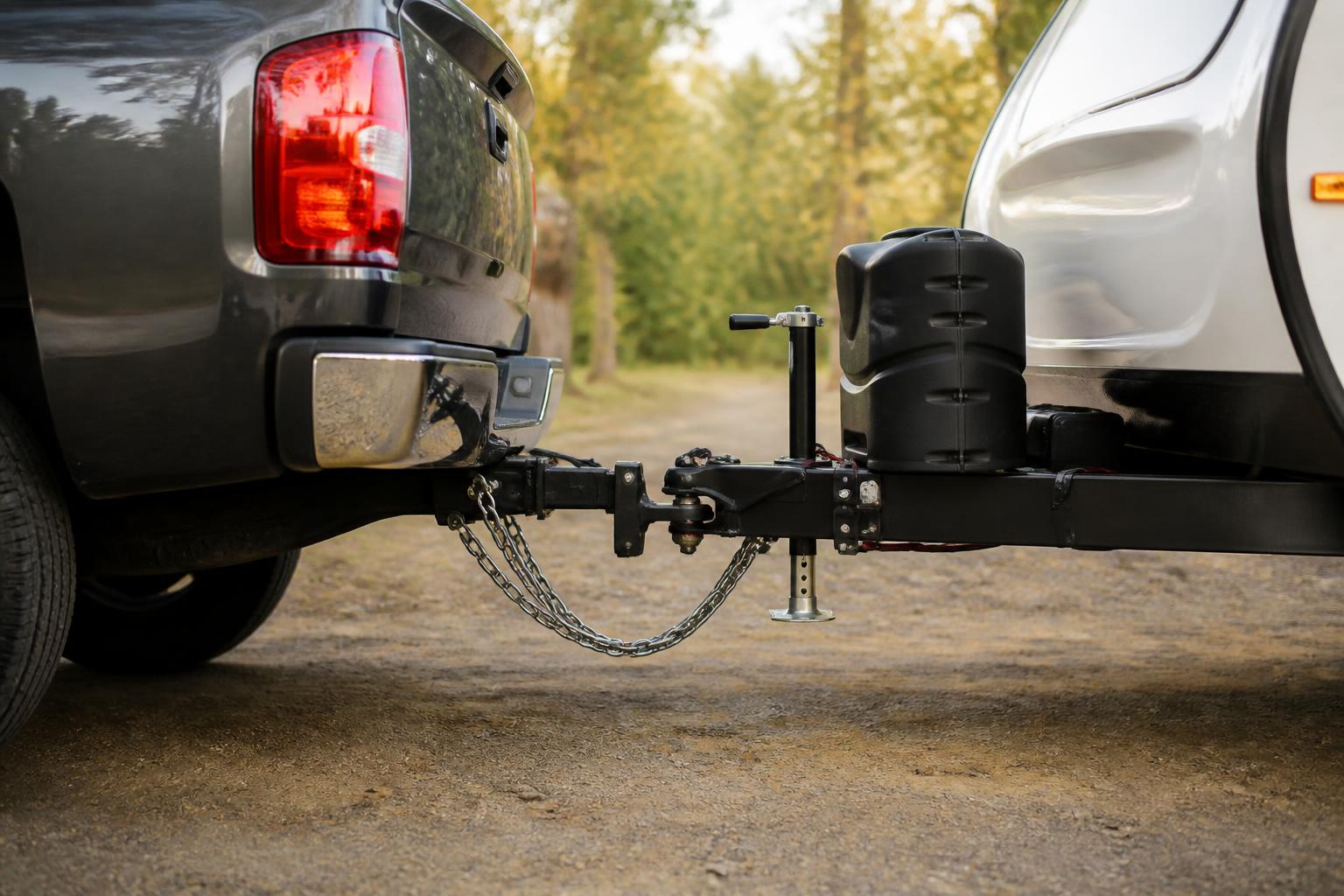

The key difference from a pop-up camper is that lightweight travel trailers have hard sides and a fixed roof — you don’t have to crank them up. Compared to a teardrop trailer, you get standing headroom (6’ to 6’4” typically) and often a small bathroom or at least a cassette toilet. The trade-off is that they weigh more than a teardrop and are more affected by crosswinds than a low-profile pop-up.
## Tow Vehicle Requirements – The Non-Negotiable
Before you look at floorplans, calculate your actual towing capacity. The SUV or minivan you already own can likely pull a lightweight camper — but only if you respect payload limits.
– **Tongue weight** for a lightweight camper runs 200–400 lbs (10–15% of total loaded weight). That weight presses on your tow vehicle’s rear axle.
– **Payload capacity** (found on the driver’s door sticker) typically ranges from 800–1,500 lbs for a mid-size SUV. Subtract passengers, cargo, and the tongue weight. If that number goes negative, you need a different camper or a vehicle with more payload.
– **Tow package required.** Many SUVs need a factory or aftermarket tow package for the transmission cooler and wiring. Don’t assume “can tow 3,500 lbs” means the vehicle comes ready from the lot.
**Common mistake:** Relying on the manufacturer’s max tow rating without checking payload. A 2024 Honda Pilot can tow 5,000 lbs, but with four passengers and gear, its payload may only allow a tongue weight of 350 lbs — limiting you to a camper with a GVWR under 3,500 lbs anyway.
## Lightweight Camper Floorplan Trade-Offs – What You Gain and What You Give Up
Every lightweight camper is a compromise. Here’s what changes based on how much weight and length you’re willing to handle:
### No Bathroom (~1,500–2,000 lbs dry)
– Pros: Lowest weight, can be towed by compact SUVs; more interior storage.
– Cons: Need campground bathhouses or a portable toilet; harder to camp in cold weather.
– **Best for:** Short weekend trips in mild weather, solo or couples who don’t mind walking to the restroom.
### Wet Bath Under 18 Feet (~2,000–2,600 lbs dry)
– Pros: The toilet and shower are inside; still fits in most driveways.
– Cons: The “shower” is usually a tiny plastic pan that splashes everything; water tank size (often 10–15 gallons) limits you to quick rinses.
– **Common complaint:** Tanks freeze in cold weather because the plumbing runs through the unheated underbelly.
### Dinette-to-Bed Converters vs. Fixed Beds
– Converters save length (20-foot model can sleep 4) but require making the bed every night.
– Fixed beds (often rear queen or bunks) add 2–3 feet of length but let you leave bedding set up.

### The Storage Mismatch That Trips Up Buyers
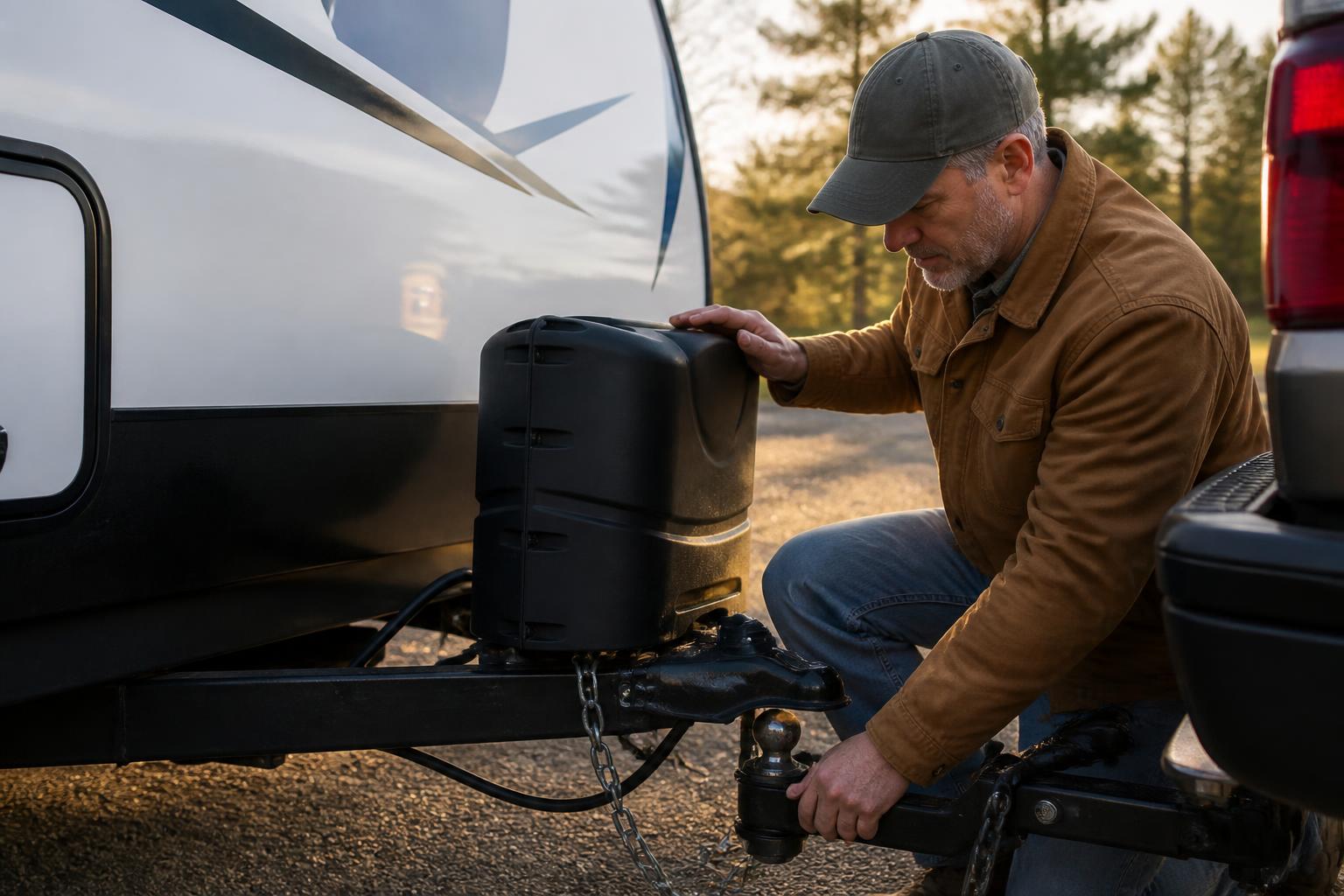
One limitation that surprises new owners: lightweight campers under 18 feet rarely have a dedicated pass-through storage compartment. That forces you to stow chairs, leveling blocks, and hoses either inside the camper (under the dinette) or in the tow vehicle. If you pack for a family of four, expect the tow vehicle’s payload to disappear fast. The practical consequence: you may need a rooftop cargo box or a hitch-mounted cargo carrier, which eats into your tongue-weight budget. For a 1,200-lb payload vehicle, that can be the difference between a safe setup and an overloaded one.
**Decision criterion that changes the recommendation:** If your tow vehicle’s payload is under 1,200 lbs, skip the wet-bath models entirely — the extra weight of a water heater, toilet, and full plumbing will eat into your cargo capacity faster than you expect. Instead, go with a no-bathroom model and carry a cassette toilet that you can store in the vehicle.
## Quick Fit Check – 5 Questions to Decide if a Specific Model Works
Run through these before you sign anything:
1. **Is the loaded tongue weight within your vehicle’s payload margin?** (Use the camper’s GVWR, not dry weight, for tongue-weight estimates.)
2. **Can you stand up fully inside?** (Headroom drops under 6’ in many ultra-light models; verify with a tape measure.)
3. **Does the camper have a dedicated pass-through storage area?** (Most lightweight campers without pass-through storage force you to stash gear in the vehicle or under the dinette.)
4. **Is the fresh-water tank large enough for a weekend of dry camping?** At least 20 gallons for two people; anything less needs a water jug backup.
5. **Will the camper fit in your driveway or storage space?** Many homeowners’ associations and storage lots are 20 feet or less. Measure twice.
**Practical implication:** If you answered “no” to question 1 or 5, stop — that model does not fit your constraints. If you answered “no” to question 3 but have a roof rack on your tow vehicle, the camper may still work, but factor in 100–150 lbs of cargo weight. No to question 4 means you’re committed to campgrounds with hookups. Use these answers to narrow the list to models that actually match your setup.
## Expert Tips to Avoid Buyer’s Remorse
**Tip 1 – Weigh your actual tow vehicle setup before buying.**
– Actionable step: Visit a CAT scale with your vehicle loaded as if you’re heading to camp (passengers, gear, full fuel). Subtract the scale weight from your GVWR to see real payload available.
– Common mistake: Doing a “paper calculation” using dry weights. A camper that’s listed at 2,500 lbs dry can easily hit 3,000 lbs loaded with water, propane, and gear — and that number matters for your safety.
**Tip 2 – Test the converter/inverter system on shore power at the dealer.**
– Actionable step: Plug the camper into 30-amp shore power and run the air conditioner, microwave, and a hair dryer simultaneously. If the interior lights flicker or the breaker trips, the electrical system is marginal.
– Common mistake: Assuming “30-amp ready” means the camper can handle full load. Many lightweights have undersized converters that struggle with simultaneous high-draw appliances.
**Tip 3 – Verify the real tongue weight with a scale, not the brochure.**
– Actionable step: At the dealer, use a Sherline tongue-weight scale on the jack post while the camper is fully loaded as delivered (battery, full propane tanks, spare tire). Write down that number. Then compare it to your vehicle’s payload allowance after subtracting passengers and gear. This one measurement eliminates guesswork.
– Common mistake: Thinking the dry tongue weight listed in the brochure is accurate. Manufacturers often list it without options like air conditioning or a second battery. Real tongue weight can be 30–50 lbs higher, which on a 1,200-lb payload vehicle pushes you into unsafe territory.
**Tip 4 – Check the tire load rating before you buy.**
– Actionable step: Look at the sidewall of each tire. The load range (e.g., “C” or “D”) must match or exceed the camper’s GVWR. Many lightweight campers ship with budget tires rated below capacity.
– Common mistake: Assuming brand-new tires are safe. A tire with load range “C” (1,820 lbs max) on a camper with a 3,500 lbs GVWR is at its limit; add any side-load from turns and you risk a blowout.
## Price Ranges and Real Ownership Costs
– **New lightweight campers:** $12,000 – $30,000 (a 17-foot no-bathroom model on the low end; a 20-foot wet-bath with slide-out on the high end).
– **Used (3–7 years old):** $5,000 – $18,000. Expect to replace tires and batteries within the first year of ownership.
– **Ongoing costs:** Registration ($100–$400/year), insurance ($200–$600/year), winterization supplies ($30/year), and tire replacement every 3–5 years ($400–$800).
**Common owner complaint:** Even “lightweight” campers are heavy to move manually. You cannot push a 2,500-lb trailer up a slight incline. Plan on always towing it into position — a tongue jack and small wheel chocks are essential.
## Essential Accessories for Your Lightweight Camper
Even a well-equipped lightweight camper benefits from a few add-ons. Below are two accessories that address common complaints — limited storage and power protection.
| Product | Price | Brand | Rating | Feature 1 | Feature 2 | Feature 3 | Best For | Score |
|———|——-|——-|——–|———–|———–|———–|———-|——-|
| [THANSTAR Collapsible Dish Drying Rack Portable Dinnerware Drainer Organizer for Kitchen RV Campers Travel Trailer Space Saving Kitchen Storage Tray](https://www.amazon.com/dp/B08PF21KKL?tag=rvownerhelp-20&linkCode=ogi&th=1&psc=1) | | THANSTAR | | | | | | |
| [CRTBETLIF RV Surge Protector 30 amp, 2026 Upgraded 13000J Surge Protection RV Circuit Analyzer 30 amp RV Surge Protector with Waterproof Cover, RV Adapter Plug for Camper, Travel Trailers](https://www.amazon.com/dp/B0FT3MBN7P?tag=rvownerhelp-20&linkCode=ogi&th=1&psc=1) | | CRTBETLIF | | | | | | |
**Top Pick:** [THANSTAR Collapsible Dish Drying Rack Portable Dinnerware Drainer Organizer for Kitchen RV Campers Travel Trailer Space Saving Kitchen Storage Tray](https://www.amazon.com/dp/B08PF21KKL?tag=rvownerhelp-20&linkCode=ogi&th=1&psc=1) – It collapses flat for storage, solves the counter-space shortage in any lightweight camper, and holds both dishes and utensils without taking over the sink. The [CRTBETLIF 30-amp surge protector](https://www.amazon.com/dp/B0FT3MBN7P?tag=rvownerhelp-20&linkCode=ogi&th=1&psc=1) is a smart buy too: lightweight campers are often plugged into older pedestals where voltage spikes are common, and a $40 surge protector is cheap insurance against a fried converter.
## Wrapping It Up
A lightweight camper is a smart way to start camping without buying a heavy-duty truck, but the trade-offs between weight, bathroom access, and storage are real. Start with your vehicle’s payload number, build your must-have list around it, and test every model at a dealer with a tape measure, a tongue-weight scale, and a plugged-in appliance load. That process will steer you to a camper that actually works for your weekender lifestyle — not just one that fits on a lot.
## Explore This Topic
– Back to [Towing & Setup](/towing-setup-hub/)
Related guides in this cluster:
– [Slide in Camper: Complete Buyer’s Guide](/slide-in-camper/)
– [Popup Camper: Complete Buyer’s Guide](/popup-camper/)
– [Choosing the Right Pop Up Camper: A Buyer’s Guide](/pop-up-camper/)
– [The Ultimate Guide to Coleman Camper](/coleman-camper/)

Practical RV guides from an experienced owner. Motorhomes, travel trailers, truck campers — we have owned them, maintained them, and written the guides we wish we had found when we started.