Ford Ranger Towing Capacity: Complete Guide
# Ford Ranger Towing Capacity: Complete Guide
The maximum [towing capacity](/f150-towing-capacity/) for a Ford Ranger ranges from 7,500 lbs (2019 and newer models with the factory tow package) to about 5,600–7,700 lbs depending on year and configuration. But here’s the failure mode most owners hit: they load up passengers and gear, then find the truck is over its GVWR before the trailer even hooks up. Payload—not the tow rating—is almost always the real limiter. A typical Ranger with 1,560 lbs of payload can only tow a 6,000–7,000 lb trailer after subtracting people and cargo.

## Quick answer


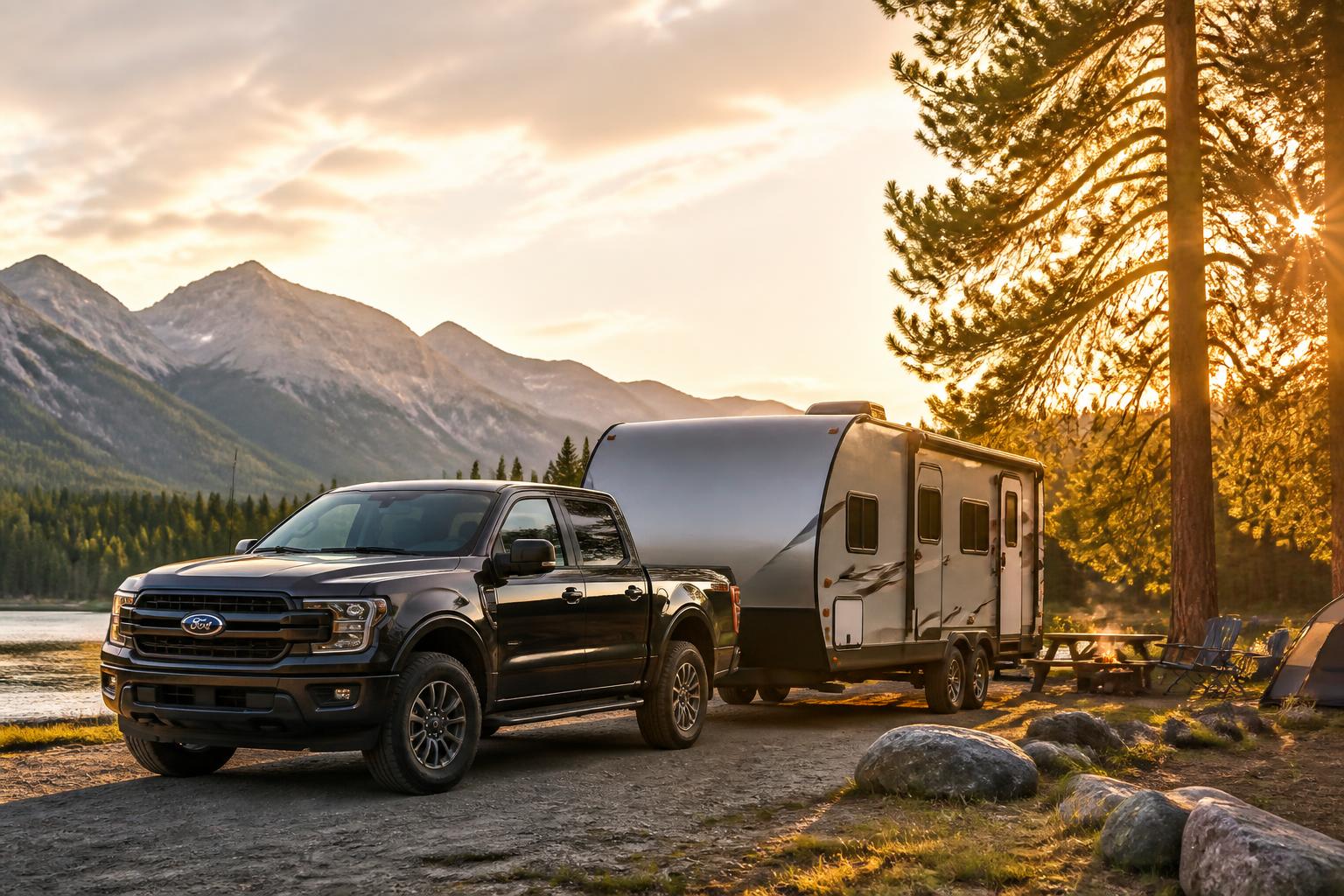
The Ford Ranger’s advertised towing capacity is up to 7,500 lbs with the factory Tow Package (2019+ models). Without it, the limit drops to 3,500 lbs. However, your actual towing limit is almost always lower because payload—the weight of passengers, gear, and tongue weight combined—runs out first. Most Ranger owners end up with a real-world limit of 4,500–5,500 lbs once the cab is full.
## What it means
Towing capacity is the drivetrain’s ceiling, but GVWR and GCWR keep you legal and safe. Here’s what those acronyms mean and why payload is the bottleneck:
– **GVWR (Gross Vehicle Weight Rating):** The maximum total weight of the truck itself—passengers, cargo, fuel, and tongue weight combined.
– **GCWR (Gross Combined Weight Rating):** The maximum weight of the truck *plus* the fully loaded trailer.
– **Payload:** GVWR minus the truck’s curb weight. This is the number that actually limits your rig. Find it on the yellow and white label on your driver’s door jamb.
– **Tongue weight:** The downward force the trailer coupler puts on the hitch ball. For a travel trailer, aim for 10–15% of the trailer’s loaded weight.

**Why payload limits so fast:** A 6,500 lb travel trailer with 13% tongue weight puts 845 lbs on the hitch. Add two adults (300 lbs), a child (75 lbs), a cooler (40 lbs), and gear (150 lbs), and you’re at 1,410 lbs—nearly the entire payload of a typical Ranger. That leaves almost nothing for the hitch itself, floor mats, or any extra cargo in the bed.
Most Ranger owners assume they can tow a 7,000 lb trailer, but the payload math often slashes that to 5,000–6,000 lbs once you add a family of four and a full cooler.
## How it works
Follow these steps to calculate what your specific Ranger can actually tow—not just the advertised max.
### Step 1: Find your payload rating
Look at the yellow and white label on the driver’s door jamb. It says “The combined weight of occupants and cargo should never exceed XXXX lbs.” Write that number down.
### Step 2: Weigh your truck ready to go
Drive to a CAT scale with a full tank of gas, all passengers you’ll normally carry, and any gear you keep in the truck. Subtract that scale weight from the GVWR to find how much payload you have left for tongue weight.
**Early checkpoint:** If your truck weight with passengers and gear is already at or near the GVWR, you’re done—you can’t tow anything without removing weight.
### Step 3: Calculate maximum trailer weight from payload
Divide remaining payload by your target tongue weight percentage. Example: 800 lbs remaining payload ÷ 0.12 (12% tongue weight) ≈ 6,667 lbs maximum loaded trailer weight.
Here’s the reality check: that 6,667 lbs is already below the advertised 7,500 lbs, and you haven’t even applied a safety margin yet.
### Step 4: Check GCWR
Add your loaded truck weight + loaded trailer weight. Must be under the GCWR listed in your owner’s manual. For a 2019+ Ranger with the tow package, GCWR is typically 14,050 lbs.
### Step 5: Apply the 80% safety margin
For daily towing, stay at 80% of your calculated maximum. This leaves room for wind, hills, and temperature changes. If your math says 6,600 lbs, aim for 5,280 lbs for routine trips.
### Likely causes of failure
– **Not weighing the truck first:** The payload sticker only shows the factory curb weight. Add accessories (tonneau cover, bed mat, floor mats, aftermarket bumper) and that 1,560 lbs drops fast.
– **Ignoring tongue weight:** Travel trailers need 10–15% tongue weight for stability. A 7,000 lb trailer at 12% puts 840 lbs on the hitch—half your payload gone before anyone sits in the cab.
– **Overloading the bed:** A full cooler, generator, firewood, and bikes can easily add 400–600 lbs, eating into payload that should have been reserved for tongue weight.
### Common friction points
– **Receiver rating:** The stock hitch receiver is stamped with its own max tongue weight. Without a weight distribution hitch, limit is 500 lbs or 10% of trailer weight, whichever is less. With a WDH, the receiver is rated for 750 lbs max tongue weight.
– **Factory tow package vs. aftermarket:** If your Ranger didn’t come with the Trailer Tow Package from the factory, you’re limited to 3,500 lbs and need to add a Class IV hitch, 7-pin connector, and trailer brake controller. Check your window sticker—you can’t just bolt on a hitch and call it capable.
– **Transmission cooling:** The factory tow package includes an upgraded radiator and transmission cooler. Towing near max capacity without it can overheat the transmission on long grades.
### When to stop and downsize
Stop towing and downsize immediately if you experience any of these:
– Truck squats visibly when the trailer is hooked up (headlights point toward the sky)
– Steering feels light or wanders at highway speeds
– Trailer sways even slightly in crosswinds or when trucks pass
– Brake pedal goes to the floor or you feel you can’t stop in normal distance
– Transmission temperature warning light comes on
### Success check
After setup, verify these on a test drive:
– Truck sits level or slightly nose-down with the trailer attached
– Braking feels firm and predictable at 25–40 mph (use a flat road for initial brake controller gain adjustment)
– No trailer sway at 55 mph in light wind
– Temperature gauges stay in normal range after a 5-mile hill climb
## Run this 5-point checklist before you connect
– [ ] Payload sticker number is known and written down.
– [ ] Truck weight with passengers and gear is under GVWR (verified at a CAT scale).
– [ ] Tongue weight of the loaded trailer is between 10–15% of trailer weight.
– [ ] Calculated max trailer weight (from payload) is less than or equal to the Ranger’s max towing capacity.
– [ ] Weight distribution hitch is used if tongue weight exceeds 500 lbs or trailer weight exceeds 5,000 lbs.
If any check fails, lighten the load or downsize the trailer—otherwise you risk bottoming out, poor braking, or losing stability at highway speeds.
## Weight distribution hitch and brake controller setup
– **Weight distribution hitch (WDH):** Ford requires a WDH for trailers over 5,000 lbs or tongue weight over 500 lbs. It uses spring bars to transfer tongue weight back to the trailer axle, leveling the truck and improving steering control. A Curt TruTrack or Equal-i-zer brand works well with Rangers.
– **Trailer brake controller:** Mandatory for trailers over 1,500 lbs. The Ranger has a factory plug under the dash for aftermarket controllers like the Tekonsha Prodigy P3. Adjust gain by braking on a flat road at 25 mph—the trailer brakes should engage smoothly without locking up. Start at gain setting 5.0 and adjust up or down in 0.5 increments.
## Key facts or takeaways
– **Payload is the real limiter.** A typical Ranger with 1,560 lbs payload can only tow a 6,000–7,000 lb trailer before subtracting people and gear. Most owners are limited to 4,500–5,500 lbs once the cab is full.
– **Towing capacity varies by trim and options.** The 2019–2024 Rangers with the Trailer Tow Package add a Class IV hitch, 7-pin connector, and upgraded cooling. Models without it are limited to 3,500 lbs.
– **80% rule.** Ford’s published numbers are for perfect conditions. For everyday mixed driving, keep towing weight at 80% of your calculated max.
– **Weigh your rig.** A CAT scale trip costs about $14 and instantly shows if you’re over any rating. Repeat after adding new gear or changing trailers.
– **Check the owner’s manual** for specific GCWR numbers by model year and drivetrain. The numbers change between 2WD and 4WD, and between SuperCab and SuperCrew. The 2024 Ranger with the 2.7L V6 has different numbers than the 2.3L version.
## Related questions
**Can a Ford Ranger tow a travel trailer?**
Yes, but travel trailers have high frontal area and significant tongue weight. A typical 22-foot travel trailer weighs 4,500–5,500 lbs loaded, which most Rangers can handle if payload allows. Always confirm loaded weight on a scale, not the brochure.
**What is the towing capacity of a 2023 Ford Ranger?**
7,500 lbs with the factory tow package, and 3,500 lbs without it. Payload is usually 1,500–1,700 lbs on the door sticker.
**Do I need a weight distribution hitch for a 5,000 lb trailer with a Ranger?**
Ford recommends a WDH for any trailer over 5,000 lbs or tongue weight over 500 lbs. Many owners use one starting at 4,500 lbs for added stability on travel trailers.
**How much tongue weight can a Ford Ranger handle?**
The receiver is rated for 750 lbs max tongue weight with a weight distribution hitch. Without WDH, the limit is 500 lbs or 10% of trailer weight, whichever is less. Always check your specific hitch’s label.
**What happens if I exceed payload or GVWR?**
Your truck will sag, steering becomes sluggish, braking distances increase, and the trailer can sway dangerously. Over time, suspension and driveline components can fail. It’s also a serious liability issue if you’re in an accident.
## Explore This Topic
– Back to [Towing & Setup](/towing-setup-hub/)
Related guides in this cluster:
– [The Complete Guide to F150 Towing capacity](/f150-towing-capacity/)
– [Understanding F 150 Towing Capacity: A Practical Guide](/f-150-towing-capacity/)
– [Toyota Sequoia Towing Capacity: What Every Owner Should Know](/toyota-sequoia-towing-capacity/)
– [F150 Tow Capacity: What Every Owner Should Know](/f150-tow-capacity/)

Practical RV guides from an experienced owner. Motorhomes, travel trailers, truck campers — we have owned them, maintained them, and written the guides we wish we had found when we started.