Finding RV Propane Refill: A Practical Guide
# Finding RV Propane Refill: A Practical Guide
You type “rv propane refill near me” into your phone, grab the address of the nearest gas station with a propane pump, and drive over. Odds are that pump won’t fill your tank. **The real filter isn’t “does this place sell propane”—it’s your tank’s valve type.** Most exchange kiosks and many gas-station pumps use the modern ACME (Type 1) connection. If you have an older OPD valve, a non-standard collar, or an unrecertified cylinder, more than half of the “propane near me” results will send you away. That wasted trip is why swapping tanks at a for-profit kiosk (often double the per-gallon cost) becomes the default.
Below is a practical breakdown of where to actually go, what to ask before you leave, a decision checklist you can run in two minutes, and three expert tips that cut the guessing—plus a safety stop threshold you don’t want to ignore.
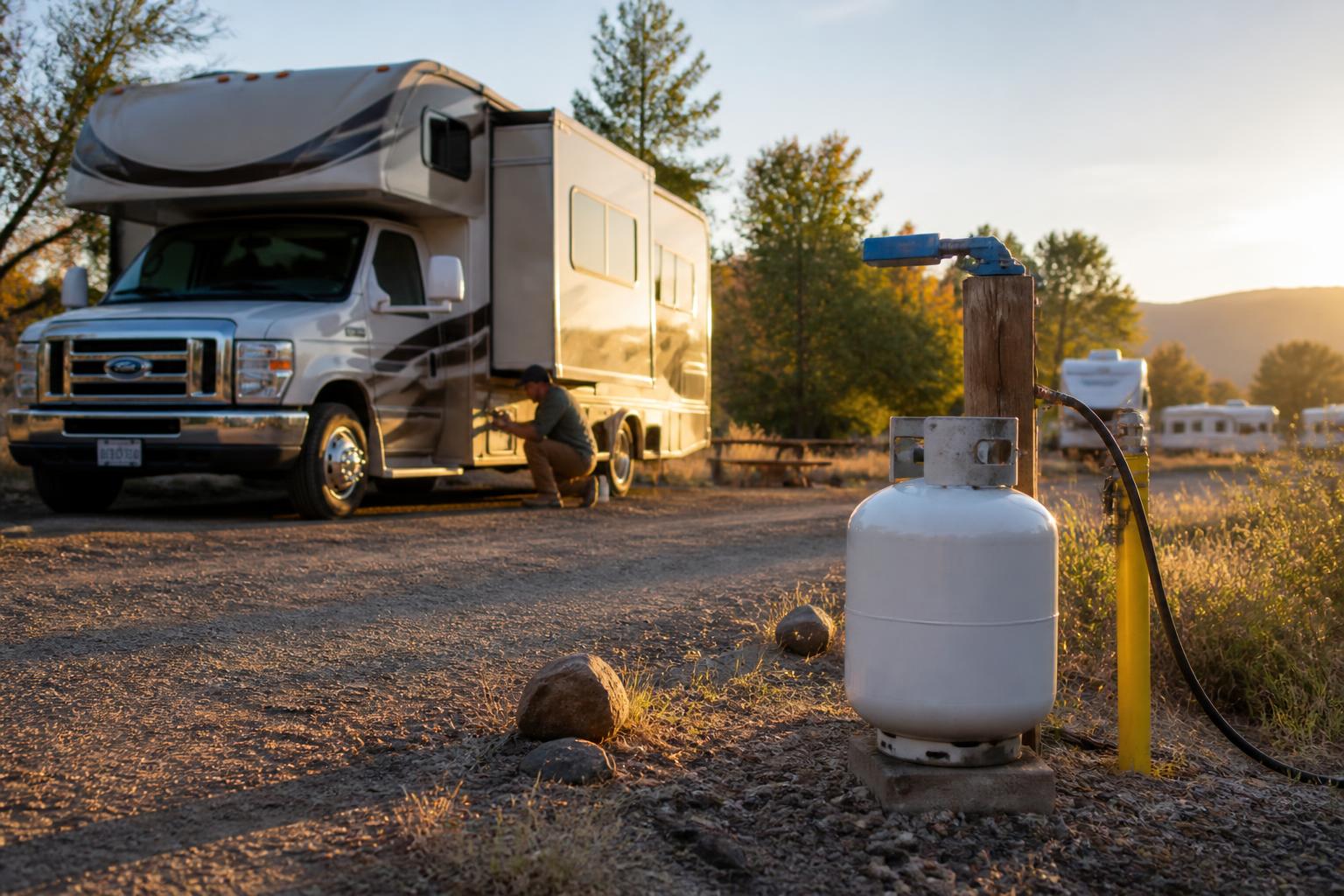
## Where to Look for Propane Refill (and What Can Go Wrong)
### Gas Stations & Truck Stops (Love’s, Pilot, Flying J)
– **Pricing:** Typically $2.50–$4.00 per gallon—cheapest option on paper.
– **Catch:** Many require a 5-gallon minimum. A standard 20-lb portable tank holds only about 4.7 gallons, so you’ll pay for a partial fill you can’t use. Some stations waive the minimum for small tanks if you ask—but you have to ask.
– **Valve compatibility:** Usually ACME. A few have adapters for OPD, but don’t assume.
– **Call-ahead question:** “Do you have a minimum gallon purchase for propane?” If yes, follow up with: “Do you ever waive it for a 20-pound portable tank?”
### U-Haul Centers
– **Pricing:** By the pound (~$3.50–$5.00 per pound), which works out a bit higher per gallon but with no minimum purchase.
– **Best for:** Small tanks, odd valve types, or topping off a partially full tank.
– **Watch out:** Propane service hours are often shorter than store hours. Many lock the gate at 5 PM even if the store stays open until 9. Call ahead for the propane desk schedule.
### Tractor Supply Co. & Other Farm/Hardware Stores
– **Pricing:** Competitive per-gallon, often no minimum.
– **Bonus:** They stock valve adapters and can sell you one on the spot if needed.
– **Location gotcha:** The propane fill is almost never inside the store—look behind the building or in a fenced yard. Ask customer service before wandering.
### Campgrounds & RV Parks
– **Pricing:** $4–$6 per gallon, highest of the options.
– **When it makes sense:** If you’re already parked and the office is open, convenience can be worth the premium.

– **Self-serve caution:** Some campground kiosks are credit-card only and may have a minimum like $5. Also, be careful with automatic shutoffs that stop before your tank is full.
## Quick Decision Checklist Before You Drive
Run through these checks for each station. If any item fails, cross that station off your list or bring the necessary workaround.
– [ ] **Tank valve type:** Is it Type 1 (ACME) or older OPD? (Stamped on the valve handle.) If OPD, do you have an adapter ($10 at Tractor Supply)?
– [ ] **Minimum purchase:** Does the station have a minimum gallon or pound requirement? If yes, will your fill meet or exceed it? (Don’t guess—call.)
– [ ] **Payment method:** Credit card accepted, or cash only? Self-serve pumps are often card-only; independent stations may be cash-only.
– [ ] **Hours of operation:** Is the propane fill open during the same hours as the main store? Many lock the propane gate at 5 PM even if the store stays open later.
– [ ] **Overfill protection:** Does the station use an automatic 80% shutoff? Safer and faster than visual gauges—ask if unsure.
– [ ] **Tank age recertification:** If your tank is more than 12 years old, some stations will refuse to fill it unless it has a current recertification sticker. Check the collar for the date.
### Branch scenario: what happens when the station refuses your valve type?

If the attendant says “we can’t fill that valve,” you have two realistic paths:
– **If you’re at a hardware store or Tractor Supply:** Ask if they sell an adapter for your valve type. A brass ACME-to-OPD adapter costs about $10 and lets nearly any pump fill an OPD tank. Buy it before you leave.
– **If you’re at a gas station or U-Haul that refuses:** Don’t argue—they usually can’t override the pump’s safety logic. Drive to the next option on your checklist.
## Expert Tips for a Smoother Refill
### Tip 1: Use exact wording when calling to trigger a straight answer
– **Actionable step:** When you call, say: “I have a 20-pound portable propane tank with a Type 1 valve. Do you fill tanks like that, and is there a minimum purchase?”
– **Common mistake to avoid:** Asking “Do you fill RV tanks?” That can mean anything. The attendant might think you mean an ASME-mounted tank and say yes, then you show up with a portable cylinder.
### Tip 2: Know your tare weight and use a bathroom scale
– **Actionable step:** Find the “TW” (tare weight) stamped on the tank collar. Before you leave, weigh the tank on a bathroom scale. Subtract TW from current weight to get pounds of propane remaining. Multiply by 0.236 to convert to gallons. Now you know exactly how many gallons you’ll need—so you can confidently ask whether the station’s minimum applies.
– **Common mistake to avoid:** Trusting the built-in float gauge. Those are notoriously inaccurate—a gauge that reads “half” can actually be 30% or 70% depending on temperature and age.
### Tip 3: Request a purge for empty or brand-new tanks
– **Actionable step:** If the tank has been empty for weeks (or is brand new), ask the attendant to purge it before filling. This removes air and moisture that cause yellow flames and soot buildup in your furnace or refrigerator burner.
– **Common mistake to avoid:** Skipping the purge because you’re in a hurry. A tank with trapped air can cause poor combustion, more frequent cleaning of burner orifices, and even damage to your RV propane appliance.
## How to Verify the Refill Worked Before You Drive Away
**Concrete step:** After the fill, ask the attendant for the final weight or read the digital display yourself. Compare it to your tare weight plus the expected fill. For a 20-lb tank, a full fill should bring the total weight to around 37–40 lbs (20-lb propane + tank weight of ~17–20 lbs). If the display shows only 30 lbs, you were underfilled—or the tank wasn’t empty.
**Leak check:** Before you reattach the tank in your RV, spray a 50/50 mix of dish soap and water on the valve threads and the new O-ring. Bubbles = leak. Do not move the RV or light any pilot until the leak is stopped. If you can’t stop the leak, shut the valve, cap the tank, and have it inspected by a propane service.
### Stop/EsCalate Threshold: When to Stop DIY and Get Professional Help
If you smell propane even after closing the valve, or if you hear a hiss from the valve stem or safety relief, **immediately close the tank valve completely, move the tank outdoors away from any ignition source, and call your local fire department’s non-emergency line or a certified propane technician.** Do not reattach the tank to your RV. Do not try to tighten the valve yourself—you can shear the stem. That threshold is concrete: a persistent propane odor or any hissing after the valve is closed means a leak you cannot fix on the road.
## When Propane Hunting Gets Old: Consider a 12V Compressor Fridge
If you’re constantly detouring for propane refills just to keep your absorption refrigerator running, a compressor fridge eliminates that problem entirely. Compressor models run on 12V DC (battery power) and don’t need propane, leveling, or long cooling cycles. They’re faster, more efficient, and give you freedom to boondock without reserving propane for the fridge.
Below is a comparison of three 12V compressor fridge options from BODEGACOOLER. All work on 12/24V DC, so you can run them off your house battery without an inverter.
| Product | Size | Key Features | Voltage |
|———|——|————–|———|
| [BODEGACOOLER 12 Volt RV Refrigerator, 80L (2.82 cu.ft)](https://www.amazon.com/dp/B0G2GHM2XR?tag=rvownerhelp-20&linkCode=ogi&th=1&psc=1) | 80L / 2.82 cu ft | APP control, separate freezer, -4°F to 68°F | 12/24V DC |
| [BODEGACOOLER 12-Volt Refrigerator, 116.2-Quart](https://www.amazon.com/dp/B0DPMWQL7R?tag=rvownerhelp-20&linkCode=ogi&th=1&psc=1) | 116.2 qt (approx 3.9 cu ft) | Dual-mode (fridge/freezer), LED display, 5°F–50°F | 12/24V DC |
| [BODEGACOOLER Upgraded 12-Volt Refrigerator, 45L (1.6 cu.ft)](https://www.amazon.com/dp/B0FVL2C932?tag=rvownerhelp-20&linkCode=ogi&th=1&psc=1) | 45L / 1.6 cu ft | APP control, lock, -4°F to 46°F | 12/24V DC |
**Top Pick:** [BODEGACOOLER 12 Volt RV Refrigerator, 80L (2.82 cu.ft)](https://www.amazon.com/dp/B0G2GHM2XR?tag=rvownerhelp-20&linkCode=ogi&th=1&psc=1) – the 80L size fits most RV kitchens, has a proper freezer compartment, and app control lets you monitor temps from your phone. Plan for at least 100Ah of lead-acid battery capacity (or 50Ah lithium) to run it overnight.
Switching to a compressor fridge cuts your propane consumption dramatically—you’ll only need propane for cooking and the [water heater](/rv-water-heater/). The upfront cost ($300–$600) and battery upgrade are real trade-offs, but if you’re tired of chasing refills, it’s a one-time fix that pays off in convenience.
Knowing your tank’s valve type and calling ahead with the right question will save you the most common wasted trips. Keep the checklist handy, use the tips above, and if the hassle becomes a regular thing, consider whether a compressor fridge makes more sense for your camping style.
## Explore This Topic
– Back to [RV HVAC & Appliances](/rv-hvac-appliances-hub/)
Related guides in this cluster:
– [RV Water Heater Buying Guide: Features to Consider](/rv-water-heater/)
– [12 Volt RV Refrigerator: Complete Buyer’s Guide](/12-volt-rv-refrigerator/)
– [RV Hot Water Heater: What to Look For & Top Picks](/rv-hot-water-heater/)
– [How to Winterize a Camper the Right Way](/how-to-winterize-a-camper/)

Practical RV guides from an experienced owner. Motorhomes, travel trailers, truck campers — we have owned them, maintained them, and written the guides we wish we had found when we started.