F150 Tow Capacity: Everything You Need to Know
The maximum tow rating on a modern F-150 can hit 13,200 pounds, but your actual towing limit is almost always lower and is set by the truck’s payload — not the brochure number. If you skip payload math, you risk exceeding GVWR, damaging the suspension, and creating dangerous sway. Here’s exactly how to determine your real F-150 tow capacity and set up safely for a travel trailer, fifth wheel, or boat.


What Actually Limits Your F-150’s Towing Capacity
Ford publishes two key numbers for every F-150 configuration:
- GCWR (Gross Combined Weight Rating) – total weight of truck, passengers, cargo, and fully loaded trailer
- GVWR (Gross Vehicle Weight Rating) – maximum weight of the truck itself (including all payload)
Your trailer can’t exceed the GCWR minus the loaded truck weight. But the more common limiter is payload — the GVWR minus the truck’s curb weight. Payload accounts for every person, every piece of gear, the hitch, and the trailer’s tongue weight. Most F-150 models have payload ratings between 1,400 and 2,300 pounds. A 13,200-pound trailer at 13% tongue weight (1,716 lbs) would blow through that payload before you add a driver.
Take a 2023 F-150 SuperCrew 4×4 with the 3.5L EcoBoost and Max Trailer Tow Package. Its payload sticker reads around 1,850 lbs. Subtract two adults (300 lbs), a hitch (100 lbs), and a cooler (50 lbs) → 1,400 lbs left for tongue weight. That limits you to a trailer GVWR of roughly 10,800 lbs (1,400 ÷ 0.13). Even if the GCWR allows 13,200, payload says stop at 10,800.
BLOCKQUOTE_0
Applicability Boundary: When This Answer Changes

The payload and GCWR numbers above apply to 2015–2023 F-150s with the 3.5L EcoBoost and Max Trailer Tow Package. If you have a 2.7L EcoBoost, a 5.0L V8, or a lower trim without the Max Tow Package, both GCWR and payload are lower. For example, a 2022 F-150 with the 2.7L and standard tow package has a max GCWR of about 13,500 lbs vs. the 3.5L’s 16,100 lbs. Payload also varies by options: the Heavy-Duty Payload Package (available on HDPP-equipped trucks) can push payload to 2,400 lbs, but most F-150s do not have it. Always verify your exact payload and GCWR by decoding the VIN or checking the Ford Towing Guide for your model year.
How to Calculate Your Real-World Tow Limit
Use this three-step math. No shortcuts.
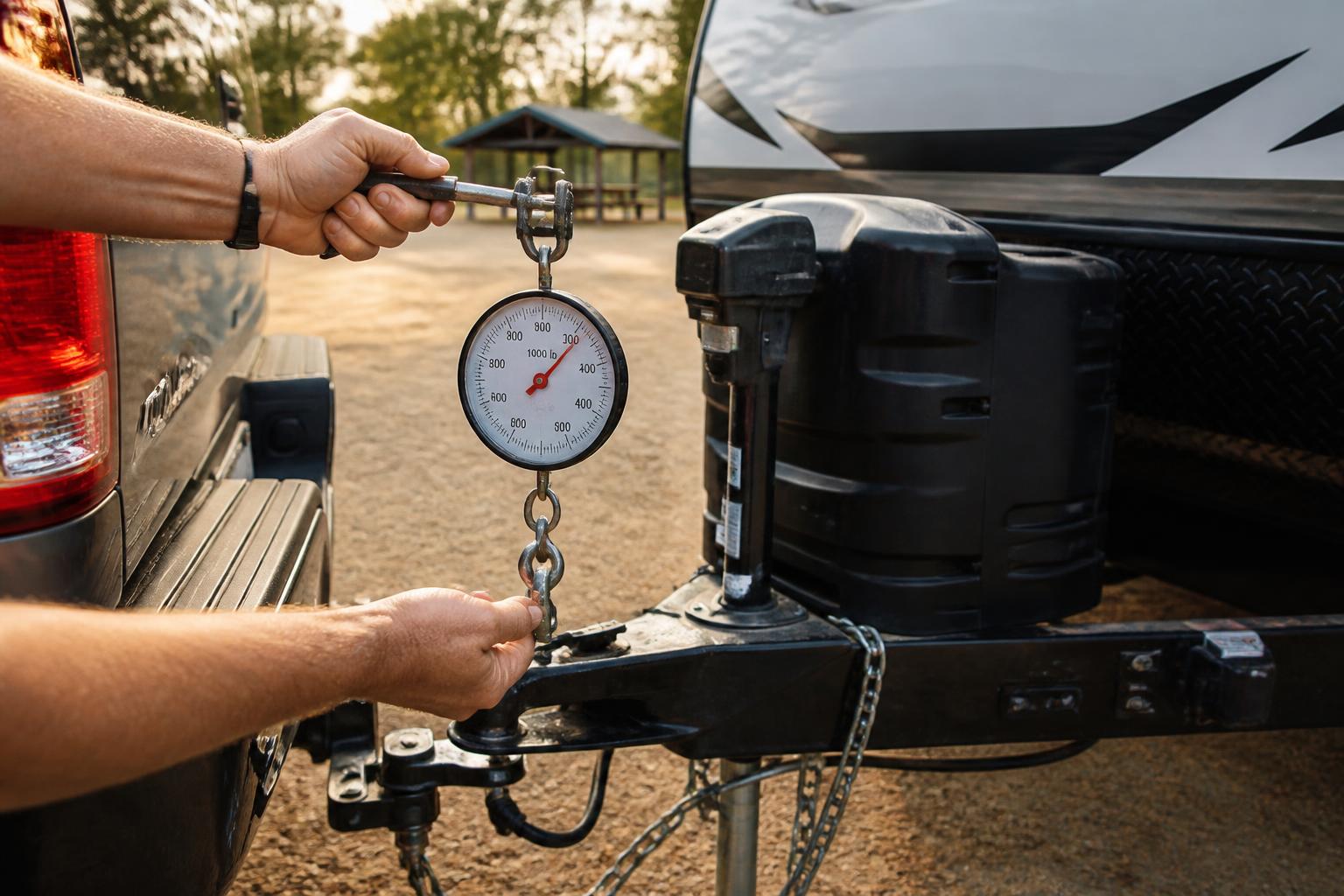
Step 1 – Weigh your truck fully loaded for camping (people, gear, pets, tools). Go to a CAT scale ($13–$15 first weigh). Record the steer axle plus drive axle weight. Subtract that from the F-150’s GVWR to get your remaining payload available for tongue weight.
Step 2 – Estimate tongue weight of the trailer you’re considering. For a travel trailer, a safe starting point is 13% of the trailer’s GVWR. For a fifth wheel, use 22–25%. For a boat, 7–10%. Example: An 8,000-lb travel trailer → 1,040 lbs tongue weight (loaded). That number must fit inside your remaining payload from Step 1.
Step 3 – Apply the 80% rule for safety margin. Even if the math says you can pull a 10,000-lb trailer at 13% (1,300-lb tongue) and your payload has 1,400 lbs left, target 80% of that: 8,000-lb trailer, 1,040-lb tongue. The margin absorbs road slope, wind, and scale errors.
Decision criterion that changes the recommendation: If your planned trailer GVWR exceeds 8,000 lbs and your payload from the door sticker is under 1,700 lbs, you must either reduce passenger or gear weight, move to a lighter trailer, or upgrade to a ¾-ton truck. No amount of weight-distribution hardware can fix a payload deficit.
Mismatch and Trade-Off: Payload vs. Tow Capacity
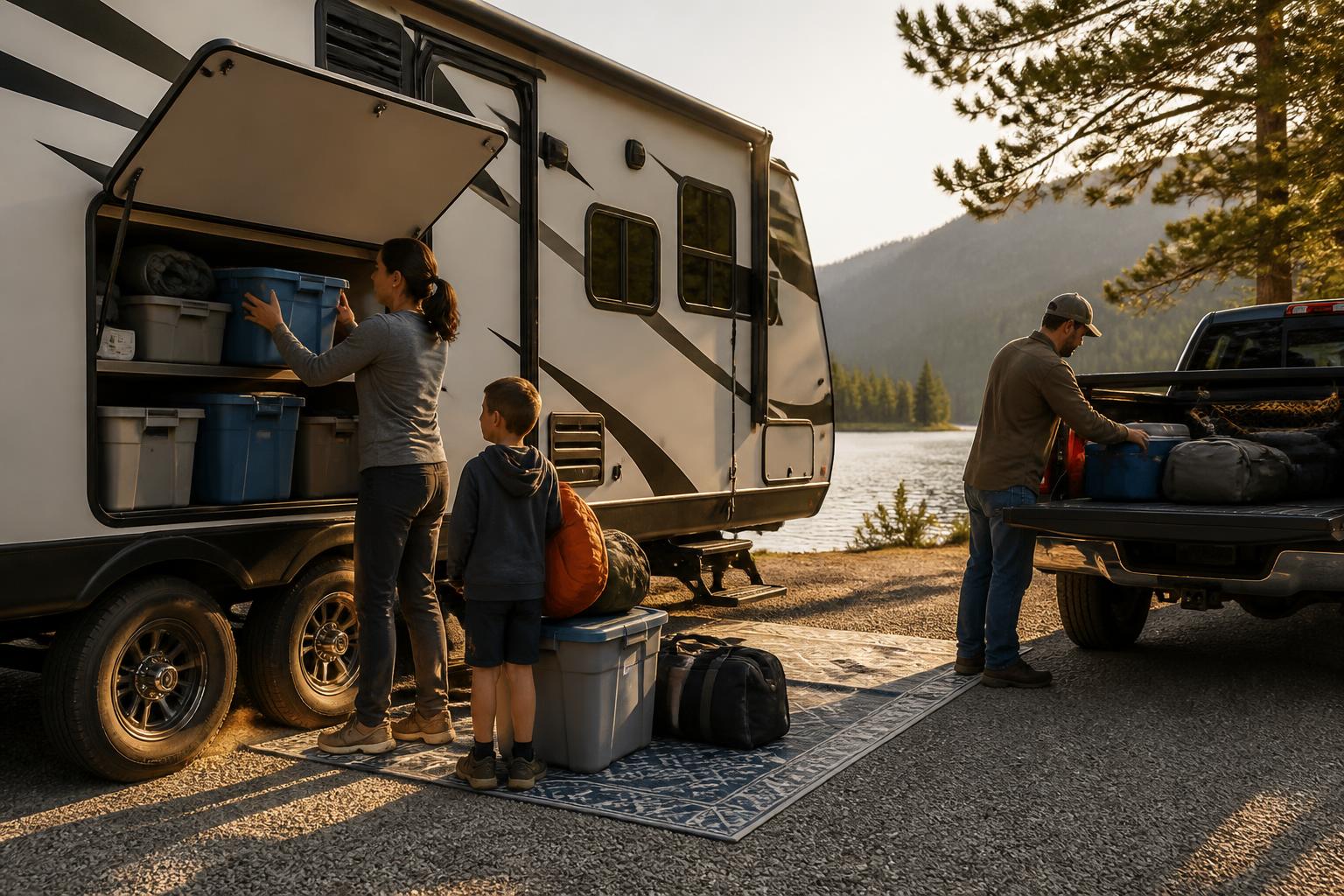
The most common mismatch is assuming the truck’s max tow rating applies to your configuration. It does not — that number comes from a stripped, single-cab, two-wheel-drive base model. Adding 4×4, a crew cab, a moonroof, or leather seats reduces payload by hundreds of pounds. Also, many online configurators show GVWR and payload for an “average” build; your actual truck may have 200–400 lbs less. The trade-off is that if you want to tow near the max, you must travel light — no heavy gear in the bed, minimal passengers, and no aftermarket accessories like bed covers or toolboxes that add weight. That’s often unrealistic for family camping trips. The safer path is to pick a trailer that leaves at least 20% headroom in payload.
Weight Distribution Hitch and Brake Controller Setup
For any trailer over 5,000 lbs GVWR, or any tongue weight over 500 lbs, a weight-distribution hitch (WDH) is mandatory — and legally required in many states. The WDH levers the hitch load across both axles, restoring front-axle steering and reducing rear sag.
Setting up the WDH
- Hitch the trailer on level ground. Measure the distance from the ground to the center of the front wheel well.
- Attach the WDH spring bars and tension them until the front fender height is within ¼ inch of the unloaded measurement.
- Confirm that the trailer is level front-to-back (adjust ball mount height if needed).
Trailer Brake Controller Gain Adjustment
- On a straight, empty road at 20 mph, manually apply the trailer brakes only (use the manual slider on your controller).
- Increase gain until you feel a firm, smooth deceleration without the trailer brakes locking or pulling.
- Test again at 25 mph with a moderate truck brake application. If the trailer pushes the truck (too little gain) or drags the truck sideways (too much), adjust in small increments.
BLOCKQUOTE_1


Verification Step: Confirm the Hitch Receiver Rating
Before relying on the WDH, check the hitch receiver’s weight capacity. On most F-150s, the factory receiver is Class IV, rated to 10,000 lbs gross trailer weight and 1,000 lbs tongue weight. Look for the stamp on the receiver tube. If your loaded trailer GVWR exceeds 10,000 lbs or tongue weight exceeds 1,000 lbs (even with WDH), you must upgrade to a Class V aftermarket receiver (e.g., Curt or Draw-Tite rated to 12,000/1,200 lbs). Ignoring this can cause the receiver to fail under load.
Expert Tips to Avoid Overloading
Tip 1 – Use a CAT Scale After Loading, Not Before
Actionable step: After loading the truck and trailer for a trip, drive to a scale, then weigh the truck only (trailer unhitched) and the truck plus trailer together. Subtract to get actual trailer GVWR. Compare that to your calculations.
Common mistake: Assuming the tongue weight printed on the trailer’s VIN sticker is the actual loaded tongue weight. Fresh water, propane tanks, and the battery can add 200–300 lbs.
Tip 2 – Account for Water and Propane in Tongue Weight Calculations
Actionable step: Add 60 lbs for a full 6-gallon water heater, 20–40 lbs for a propane tank, and 8.3 lbs per gallon of fresh water in the fresh tank if it’s forward of the axles. Most travel trailers have tanks forward — that weight goes onto the tongue.
Common mistake: Thinking the dry tongue weight from the manufacturer is your real tongue weight. It’s usually 200–400 lbs less than a loaded trailer.
Tip 3 – Watch Your Rear Axle GAWR Separately
Actionable step: Look at the rear axle GAWR on the door sticker. Even if total payload is okay, a heavy tongue can overload the rear axle before the front axle lightens. After setting up the WDH, weigh just the rear axle to ensure it’s under the GAWR.
Common mistake: Only checking GVWR and ignoring individual axle ratings. A trailer with excessively short tongue (poor weight distribution) can push the rear axle past its limit even with GVWR under spec.
Quick Decision Aid: Is Your F-150 Ready to Tow?
Run through these checks before committing to a trailer.
- Payload pass: Passengers + gear + hitch + tongue weight ≤ door sticker payload rating.
- Tongue weight range: Travel trailer tongue weight is 11–15% of loaded trailer GVWR; fifth wheel is 22–25%. Measure or estimate.
- Hitch class: The F-150 factory receiver is typically Class IV (10,000/1,000 lb capacity). If your setup exceeds those numbers, you need an aftermarket Class V hitch.
- Brake controller: Required for any trailer over 3,000 lbs. The Ford factory integrated controller is best; aftermarket controllers (e.g., Prodigy P3) work fine but require proper gain setup.
- 80% rule applied: Your target trailer GVWR ≤ 80% of the maximum your payload math supports. This gives you room for unexpected headwinds or scale errors.
If you fail any check, reconsider the trailer or the truck. A heavier truck (F-250 or F-350) may be the better long-term choice for a large travel trailer.
Frequently Asked Questions
Can a 2023 F-150 tow a 30-foot travel trailer?
Yes, if the trailer’s GVWR is under about 9,500 lbs and your payload is at least 1,400 lbs after accounting for passengers and gear. Many 30-foot trailers have GVWRs in the 7,000–8,500 lb range. Always run the payload math first.
What’s the maximum fifth wheel an F-150 can tow?
Ford lists a max fifth wheel rating of around 10,000–12,000 lbs on certain F-150 models with the heavy-duty payload package. In practice, fifth wheels have high pin weights (22–25% of GVWR), so the payload requirement is steep. A 10,000-lb fifth wheel needs 2,200–2,500 lbs of payload, which exceeds almost all F-150s. Realistically, F-150s work only with small fifth wheels under 8,000 lbs GVWR and low pin weight.
Does the 80% rule apply differently for a fifth wheel versus a travel trailer?
Yes. For a travel trailer, the 80% rule applies to both tongue weight and overall trailer GVWR. For a fifth wheel, focus on pin weight staying under payload — the 80% margin is even more critical because fifth wheels transfer more weight to the truck bed and because sway recovery is harder with a high center of gravity.

Practical RV guides from an experienced owner. Motorhomes, travel trailers, truck campers — we have owned them, maintained them, and written the guides we wish we had found when we started.