30 Amp Plug: What Every Owner Should Know
# 30 Amp Plug: What Every Owner Should Know
A 50‑amp RV plug (NEMA 14‑50P) delivers up to 12,000 watts of power over two 120V hot legs. It’s the standard for large travel trailers, fifth wheels, and motorhomes that need to run multiple air conditioners, a microwave, and electric water heaters simultaneously.


## Quick Answer
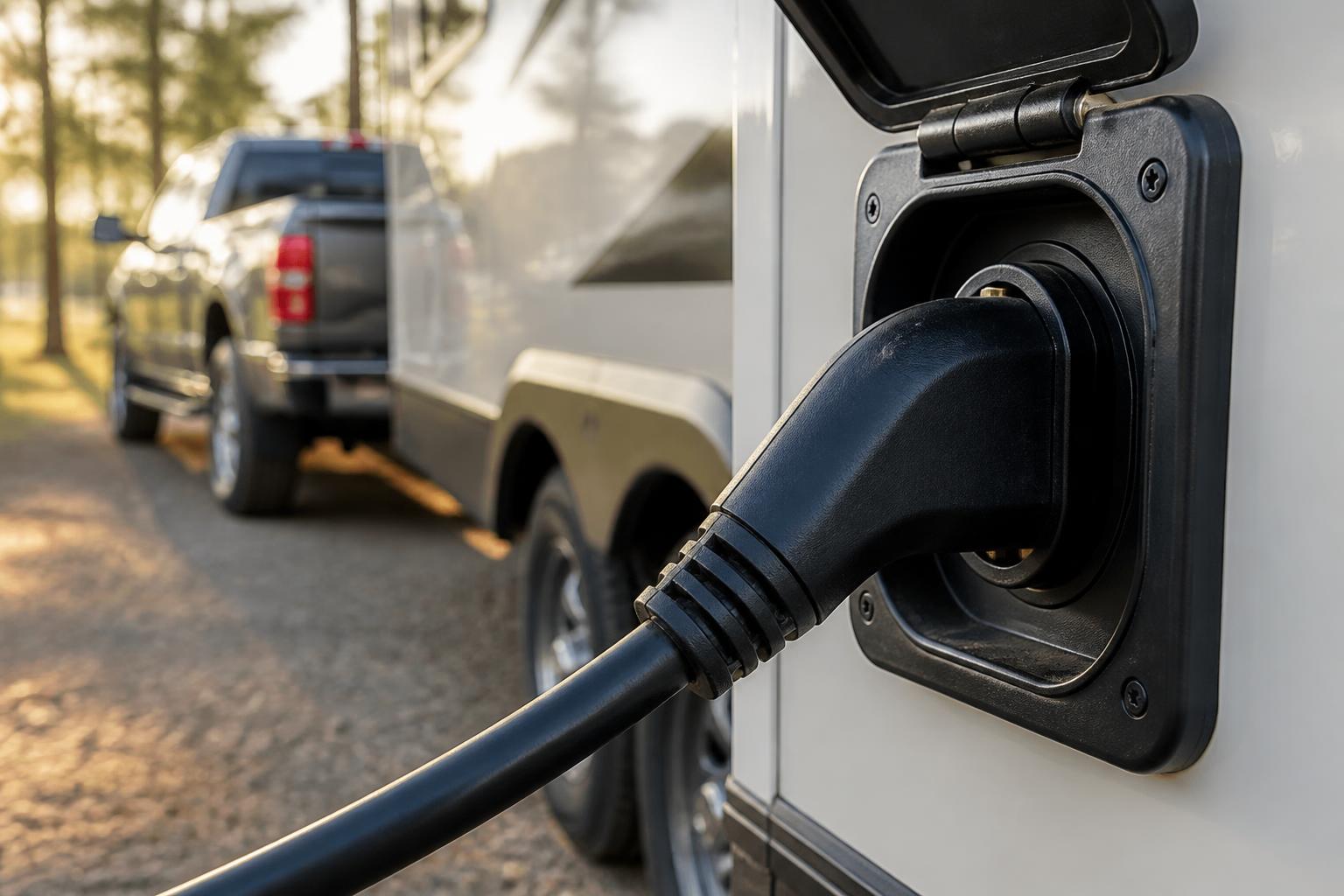

A 50‑amp RV plug is a 4‑prong connector (two hot wires, one neutral, one ground) that supplies 120/240 V at up to 50 A per hot leg. Total usable 120 V capacity is 12,000 W — roughly 3.3 times what a 30‑amp plug provides. If your RV has two roof AC units or you routinely run the AC, microwave, and water heater together, you need 50‑amp service.
## What a 50‑Amp RV Plug Can Actually Handle
The real advantage isn’t just total wattage — it’s how the power is split. Inside the RV’s power panel the two 50‑amp legs (L1 and L2) each feed separate 120 V circuits. That means Leg A can run the living room AC and microwave while Leg B runs the bedroom AC and electric water heater, all without tripping a breaker.
Compare that to a 30‑amp RV, which runs everything off a single 120 V leg limited to 3,600 W. With 50‑amp you get a second independent circuit that can handle the same high loads.
### 30‑Amp vs. 50‑Amp: Quick Comparison
| | 30‑Amp Service | 50‑Amp Service |
|————————–|————————————-|————————————-|
| **Plug type** | NEMA TT‑30R (3‑prong) | NEMA 14‑50R (4‑prong) |
| **Total 120V capacity** | 3,600 W | 12,000 W |


| **Typical RV size** | Under 30 ft, pop‑ups | Over 30 ft, fifth wheels, large motorhomes |
| **Can you adapt?** | Yes – dogbone to 50‑A pedestal (limited to 30A) | No – reverse adapter is dangerous |
**One decision criterion that changes the recommendation:** If you mostly stay at full‑hookup parks with two AC units, 50‑amp is non‑negotiable. But if you boondock and rely on solar, the extra weight of heavier wiring, a larger transfer switch, and a bigger battery bank may not be worth it — a well‑sized 30‑amp system with a good inverter can cover most off‑grid needs.
## How to Safely Connect and Use a 50‑Amp RV Plug
### Preparation and Early Checkpoints
Before plugging in, verify these items to avoid damage or fire:
– **Inspect the pedestal receptacle** – it must be a NEMA 14‑50R with four slots. Cracks, burn marks, or loose fit mean you need a different site.
– **Check your cord** – look for cuts, melted spots, or corrosion on the prongs. Damaged cords overheat under full load.
– **Turn the pedestal breaker OFF** before plugging in to prevent arcing.
**Early branch point:** If the receptacle looks damaged, do not plug in. Ask the park to move you. A poor connection can melt your plug even if the breaker holds.
### Ordered Steps to Connect
1. **Turn OFF the main breaker on your RV’s power panel.** This protects the converter and appliances from power spikes.
2. **Plug the RV cord into the pedestal receptacle firmly** until the locking ring is flush. If it has a twist‑lock collar, turn clockwise to lock.
3. **Turn ON the pedestal breaker.** Listen for buzzing or sizzling — stop immediately if you hear or smell anything.
4. **Turn ON your RV’s main breaker.** Wait 30 seconds for the converter to stabilize before switching on loads.
5. **Test one high‑draw appliance at a time** — microwave, then AC, then water heater. If the pedestal breaker trips, you have a load imbalance or faulty connection.
### Likely Causes of Trouble
| Symptom | Probable Cause |
|——————————|———————————————|
| Pedestal breaker trips immediately | Short in the cord or RV power panel |
| Only half the outlets work | One hot leg dead — check pedestal breaker or park wiring |
| Cord feels warm to the touch | Loose connection at the plug or undersized extension cord |
| AC kicks off after a few minutes | Overloaded leg – move some loads to the other leg |
### Friction Points
– **Heavy cord** – a 50‑amp cord weighs 10–15 lb for 25 feet. Use a cord support stand or bungee loop to take weight off the plug connection.
– **Short pedestal reach** – if you need extra length, use a 50‑amp extension cord rated for 50 A continuous. The [PlugSaf NEMA 14‑50P/14‑50R 25 FT 50 Amp RV/EV Extension Cord](https://www.amazon.com/dp/B0BZV24ZZF?tag=rvownerhelp-20&linkCode=ogi&th=1&psc=1) (ETL‑listed, STW jacket) handles the load safely and has grip handles for easy plugging. For a longer run, the [30‑foot version](https://www.amazon.com/dp/B0BZVSZ2J8?tag=rvownerhelp-20&linkCode=ogi&th=1&psc=1) or [50‑foot version](https://www.amazon.com/dp/B0BZV1ZT3N?tag=rvownerhelp-20&linkCode=ogi&th=1&psc=1) work well but expect more weight to coil.
### Escalation Signals – When to Stop and Get Help
– **Sparks or arcing when plugging in** – stop immediately. Have the pedestal checked by park staff.
– **Breaker trips more than once** – call an electrician. Repeated resets can cause a fire.
– **Burning smell from the cord or pedestal** – shut everything off and disconnect. A melted neutral wire inside the plug can start a fire.
### Concrete Verification Step – Confirm It’s Working
After connecting and turning on the main breaker:
1. **Check your RV’s power panel.** Most 50‑amp systems show voltage for Leg A and Leg B. You should see 120 V on both. If one leg shows zero, a hot wire isn’t connected.
2. **Run the largest AC unit and the microwave simultaneously.** If neither trips a breaker and voltage stays above 110 V, your connection is sound. Voltage dropping below 105 V indicates a loose or corroded connection somewhere.
## Decision Aid: Do You Actually Need 50‑Amp?
This quick checklist helps you decide if 50‑amp is right for your RV or next purchase. A “no” means 30‑amp will likely suffice.
– [ ] The RV has two roof air conditioners (or a heat pump plus an AC).
– [ ] You plan to run the microwave, AC, and electric water heater at the same time.
– [ ] Your RV’s power cord uses a 4‑prong plug (not 3‑prong).
– [ ] You stay at full‑hookup campgrounds most of the time.
– [ ] The RV’s spec sticker shows a 50‑amp service rating.
If you checked three or more, a 50‑amp setup is the right fit. If only one or two, a 30‑amp system with a good inverter can serve you better — and save hundreds of pounds in wiring and battery weight.
## Key Facts: Wire Gauge, Adapters, and Compatibility
### Wire Gauge
Factory 50‑amp RV wiring uses 6‑gauge copper for the hot and neutral wires and 10‑gauge for ground. If you’re installing a new pedestal at home, local code typically requires 6‑AWG copper on a 50‑amp double‑pole breaker. Do not substitute aluminum wire unless the breaker and connectors are rated for it.
### Adapter Do’s and Don’ts
– **30‑to‑50‑amp dogbone adapter** – **Do** use it to plug a 30‑amp RV into a 50‑amp pedestal, but limit your load to 3,600 W (30 A total). **Don’t** plug a 50‑amp RV into a 30‑amp outlet with a reverse adapter — the RV will try to draw 50 A and melt the 30‑amp wiring.
– **50‑to‑30‑amp dogbone** – **Don’t** use it. The plug shapes are incompatible and forcing them damages both.
– **14‑50 to TT‑30 adapter** – Only for emergency use. It reduces a 50‑amp pedestal to a single 30‑amp circuit; you lose one hot leg and total capacity drops to 3,600 W.
### Extension Cord Length and Ampacity
Any 50‑amp extension cord must be rated for 50 A continuous. Look for 6‑gauge wire, STW or SJTW jacket, and NEMA 14‑50P/14‑50R ends. A 25‑foot cord works for most sites; a 50‑footer adds extra reach but more weight. The cords mentioned above all meet these specs and include grip handles for easier use.
## Related Questions
### Can I run a 50‑amp RV on a generator?
Yes, but the generator must deliver 240 V and at least 50 A (12,000 W running). Most 12 kW‑class units have a NEMA 14‑50R receptacle. Smaller generators (e.g., 8 kW) produce only 120 V, which powers only one leg of your RV panel — you’ll lose half your outlets and risk overloading the generator.
### Why does my 50‑amp RV have a 30‑amp power cord?
Some smaller RVs (under 30 feet) come with a 50‑amp power center but a 30‑amp cord to save weight. You can upgrade the cord to 50‑amp, but you may also need a larger transfer switch, breaker, and inlet. Check your RV’s electrical specs — many “50‑amp ready” models only need a cord swap.
### Can I charge my EV with a 50‑amp RV plug?
Yes. A NEMA 14‑50R receptacle is the same outlet used for Level 2 EV charging. Most portable EV chargers come with a 14‑50P plug. Just make sure the pedestal or home outlet can handle the continuous 32 A or 40 A draw typical for EV charging, and that the RV pedestal isn’t shared with other loads.
## Explore This Topic
– Back to [RV Electrical & Solar](/rv-electrical-solar-hub/)
Related guides in this cluster:
– [RV Trailer: Everything to Know Before Buying](/rv-trailer/)
– [Camping Trailer: Everything to Know Before Buying](/camping-trailer/)
– [RV Surge Protector Buying Guide: Features to Consider](/rv-surge-protector/)
– [Choosing the Right RV Generator: A Buyer’s Guide](/rv-generator/)

Practical RV guides from an experienced owner. Motorhomes, travel trailers, truck campers — we have owned them, maintained them, and written the guides we wish we had found when we started.