The Ultimate Guide to RV Financing
Financing an RV is not like financing a car. Longer terms, higher rates, and a depreciation curve that can leave you underwater before your first camping season are all part of the deal. The single biggest mistake buyers make is focusing only on the monthly payment without understanding the total cost, loan structure, or how quickly the RV loses value. This guide shows you where to look for the traps and how to match financing to your actual plan.
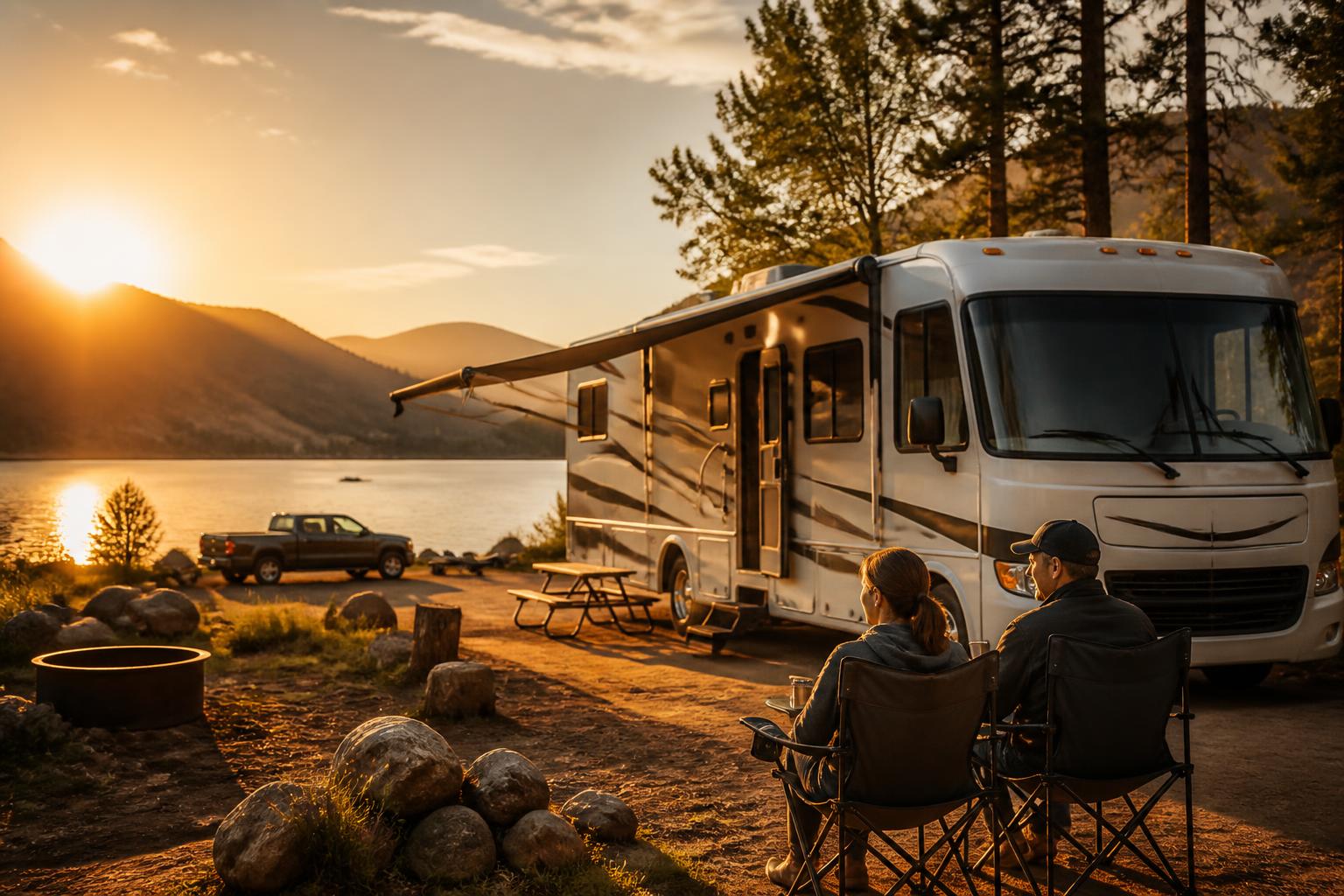

The One Mistake That Costs Thousands
Lenders love to quote monthly payments stretched over 15 or 20 years. A $60,000 camper at 8% for 20 years works out to roughly $500/month. Sounds manageable. The problem is that after three years, that same camper may be worth $35,000–$40,000 (RVs lose 20–30% in the first two years). Your loan balance? Still around $55,000. You now owe $15,000–$20,000 more than the RV is worth. If you need to sell, trade, or if the RV is totaled, you absorb that gap.

How to detect this early. Ask the lender for the amortization schedule and compare the loan balance at year 3 to the estimated resale value using NADA Guides or JD Power. If the loan exceeds the expected value by more than 10% of the purchase price, you need a shorter term or a larger down payment. This rule applies to all RV types—travel trailers, fifth wheels, and motorhomes—but the depreciation hit is steeper on lower-end models and less severe on premium brands like Airstream or Newmar.
Before You Sign: A 6-Point Financing Check
Run through these checks before committing to any loan offer. Each is a pass/fail test. If you fail even two, reconsider the deal or look for alternative financing.
1. Total interest cost. Multiply the monthly payment by the number of payments and subtract the principal. If the interest exceeds 40% of the purchase price on a new RV, the term is too long or the rate too high.
2. Loan term vs. ownership horizon. Do you plan to keep this RV longer than the loan term? If not, you risk negative equity at trade-in. A 15-year loan only makes sense if you intend to own the RV for 15+ years.
3. APR includes all fees. The interest rate is not the full cost. Ask for the APR, which includes origination fees, documentation fees, and any mandatory add-ons. A 7% rate with a 2% origination fee is effectively a higher cost.
4. Prepayment penalty. Some RV loans charge a fee if you pay off early. If you might sell or refinance within five years, this penalty can erase any savings. Demand a loan with no prepayment penalty.

5. Down payment vs. 20% threshold. Lenders often require 10–20% down for new RVs and 15–25% for used. If you put down less than 20%, expect higher rates and a higher chance of being underwater early. Check what the lender requires for both rate and negative-equity protection.
6. LTV (loan-to-value) after one year. Ask the lender to project the LTV at 12 months using their depreciation multiplier. If the LTV exceeds 100%, you are upside down. Walk away or negotiate a lower price.
How to Get RV Financing: Step-by-Step
The process is straightforward, but the order matters. Rushing to the dealer first is the most common mistake.
Step 1: Know your credit and your budget
Pull your credit score (FICO 8 or 9; RV lenders often use auto-enhanced models). Get pre-qualified with a credit union or online lender that specializes in RV loans. This gives you a benchmark rate and shows you the maximum monthly payment you can handle without straining your regular expenses.
Step 2: Get at least two outside offers
Contact a credit union (many have RV-specific loan departments), a national bank, and an online RV lender like LightStream or BMO. Compare APRs, terms, and fees side by side. A credit union may offer 1–2 percentage points lower than a dealer’s captive lender. Early checkpoint: If your credit score is below 660, expect higher rates (10–14%) and shorter terms. Improve your score or plan a larger down payment before shopping.
Step 3: Let the dealer earn your financing—on your terms
When you find a specific RV, tell the dealer you have outside financing but ask them to beat it. Dealers often have access to promotional rates or manufacturer-subsidized loans (common on new units). Only accept the dealer’s offer if the APR is lower and the terms are equal or better.
Step 4: Keep the loan and the purchase price separate
Negotiate the out-the-door price of the RV before discussing financing. A dealer may offer a low monthly payment by extending the term or inflating the purchase price. Agree on the price first, then compare loan offers on that agreed number.
Step 5: Review the contract for hidden add-ons
Check for line items like “GAP waiver,” “extended warranty,” “tire-and-wheel protection,” or “credit insurance.” Some are negotiable; others are high-margin dealer profit. You can add extended warranties later; buying them in the finance office often inflates the loan amount.
Step 6: Secure funding and complete the inspection
Once the loan is approved, do not hand over the full payment until you have completed a Pre-Delivery Inspection (see below). Success signal: If the RV passes inspection with no defects and the loan paperwork matches the agreed terms, you are clear to complete the deal. If the dealer resists a thorough PDI, that is a stop sign—walk away.
New vs. Used: How Depreciation Changes Your Loan
New RVs depreciate 20–30% in the first two years and about 50% over five years. A $100,000 motorhome can be worth $50,000–$60,000 after five years. If you finance 100% of the purchase price on a 15-year term, you will be underwater for most of the loan’s early years.
Here is what that means for your next move. If you buy new, plan for the first two to three years of negative equity. That makes it harder to trade in, sell, or get out of the loan if your situation changes. The safest hedge is a 20% down payment and a term no longer than 10 years for a new unit.
Used RVs (3–5 years old) have already taken the biggest hit. Depreciation slows after year three. Financing a used unit means a lower loan amount, shorter term (lenders typically cap used RV loans at 10–12 years), and a better chance of staying above water. Rates on used RVs are usually 1–2% higher than new, but the total interest cost is lower because the principal is smaller.
When new financing can work: You plan to keep the RV for 10+ years, you put at least 20% down, and you negotiate a price below MSRP (10–15% off is common on large dealers’ lots). Otherwise, the depreciation math heavily favors buying used.
A concrete trade-off: Consider a $70,000 new travel trailer versus a $45,000 three-year-old model of the same brand. The new unit at 7% for 15 years costs roughly $629/month, total interest around $43,000. The used unit at 8.5% for 10 years costs about $558/month, total interest around $22,000. Over the life of the loan, you save $21,000 in interest and have a lower monthly payment—plus the used RV is worth nearly the same relative to the loan balance after a few years.
Dealer Financing vs. Credit Union vs. Bank
Each source has distinct trade-offs.
| Lender type | Typical APR (2024–2025) | Term range | Best for |
|---|---|---|---|
| <strong>Credit union</strong> | 6–9% | 10–15 years (new); 8–12 years (used) | Borrowers with good credit (680+) who want low rates and no prepayment penalties. |
| <strong>Online lender</strong> | 7–11% | 10–20 years | Quick approvals, competitive rates for excellent credit. May have fees. |
| <strong>Bank (e.g., BMO, Wells Fargo)</strong> | 8–12% | 12–20 years | Borrowers with established banking relationships; can bundle auto-pay discounts. |
| <strong>Dealer captive (e.g., Thor, Forest River)</strong> | 7–13% | 12–20 years | Promotional rates on new units; easy but often higher base APR; add-on pressure. |
Skeptical note: Dealer captive financing often looks attractive with a 0.9% or 1.9% teaser rate on new inventory. Read the fine print—those rates may require a short term (3–5 years), a large down payment, and excellent credit. If you don’t qualify, the standard rate may be above 10%. Always compare with a credit union offer first.
Extended Warranties: When They Make Sense (and When They Don’t)
Extended RV warranties (service contracts) cost $1,500–$4,000 depending on coverage and deductible. They cover major mechanical failures (appliances, AC, furnace, slide-out mechanisms) but exclude normal wear, seals, and roof maintenance.
When they are worth it: You are buying a new or nearly-new RV and plan to keep it beyond the factory warranty (usually 1–2 years). The first year is often a “shakedown” year with numerous small fixes—most of those are covered under the factory warranty anyway. An extended warranty makes more sense starting in year three.
When they are not worth it: You buy a used RV that is already 5+ years old. Many warranty providers will limit coverage or charge higher deductibles. You also pay a premium that could instead be set aside as a repair fund. For a $30,000 used trailer, a $2,000 warranty buys less than a dedicated repair fund that earns interest.
The failure mode: Financing the warranty into the loan. You pay interest on the warranty cost for the entire loan term. That $2,000 warranty could cost $3,500+ over 15 years at 8%. Pay cash for the warranty if you decide to buy one, or skip it entirely and self-insure.
Pre-Delivery Inspection (PDI): Don’t Skip This Before Funding
Lenders will disburse the loan once you sign the purchase documents. If you find a serious defect after that, you are stuck negotiating with the dealer without the leverage of withholding payment.
Do this during the PDI:
- Test all appliances (fridge on gas and electric, stove, microwave, water heater on both modes).
- Run the AC and furnace for at least 15 minutes each.
- Check all slide-outs for smooth operation and proper seal.
- Inspect the roof for soft spots, bubbles, or sealant gaps.
- Verify all lights, outlets, and the inverter/converter function.
- Check tire age (manufacture date code) and pressure.
- Look for water stains inside cabinets and under sinks.
If the dealer refuses a thorough PDI or tries to rush you, that’s a red flag. Walk away or insist on a written commitment to fix any issues found within 30 days. A good dealer expects this and will cooperate.
The Bottom Line
RV financing works well when you treat the loan as a tool that matches your ownership timeline and the RV’s real depreciation curve. The safest path: buy a 3–5 year old used RV, put 20% down, finance through a credit union on a 10–12 year term, and keep the warranty decision separate from the loan. If you go new, negotiate the price first, bring outside financing as leverage, and be prepared for the first two years of negative equity. A monthly payment that looks comfortable today can become a trap if you haven’t looked at the amortization schedule and the resale value together. Do that math first, and you’ll drive away knowing you’re not underwater before you leave the lot.

Practical RV guides from an experienced owner. Motorhomes, travel trailers, truck campers — we have owned them, maintained them, and written the guides we wish we had found when we started.