Pop Up Camper: Complete Buyer’s Guide
A pop-up camper (also called a folding camper or tent trailer) is a lightweight, collapsible RV that offers an affordable entry into camping without requiring a full-size tow vehicle. It folds down into a low-profile trailer for towing and storage, then expands via canvas walls and a crank lift into a livable space with beds, a small kitchen, and often a dinette. But the trade-offs matter—setup time, canvas maintenance, limited insulation, and tow-vehicle compatibility make it a better fit for some buyers than others. The single most decision-changing factor isn’t price or features: it’s whether your tow vehicle can safely handle the camper’s loaded weight.
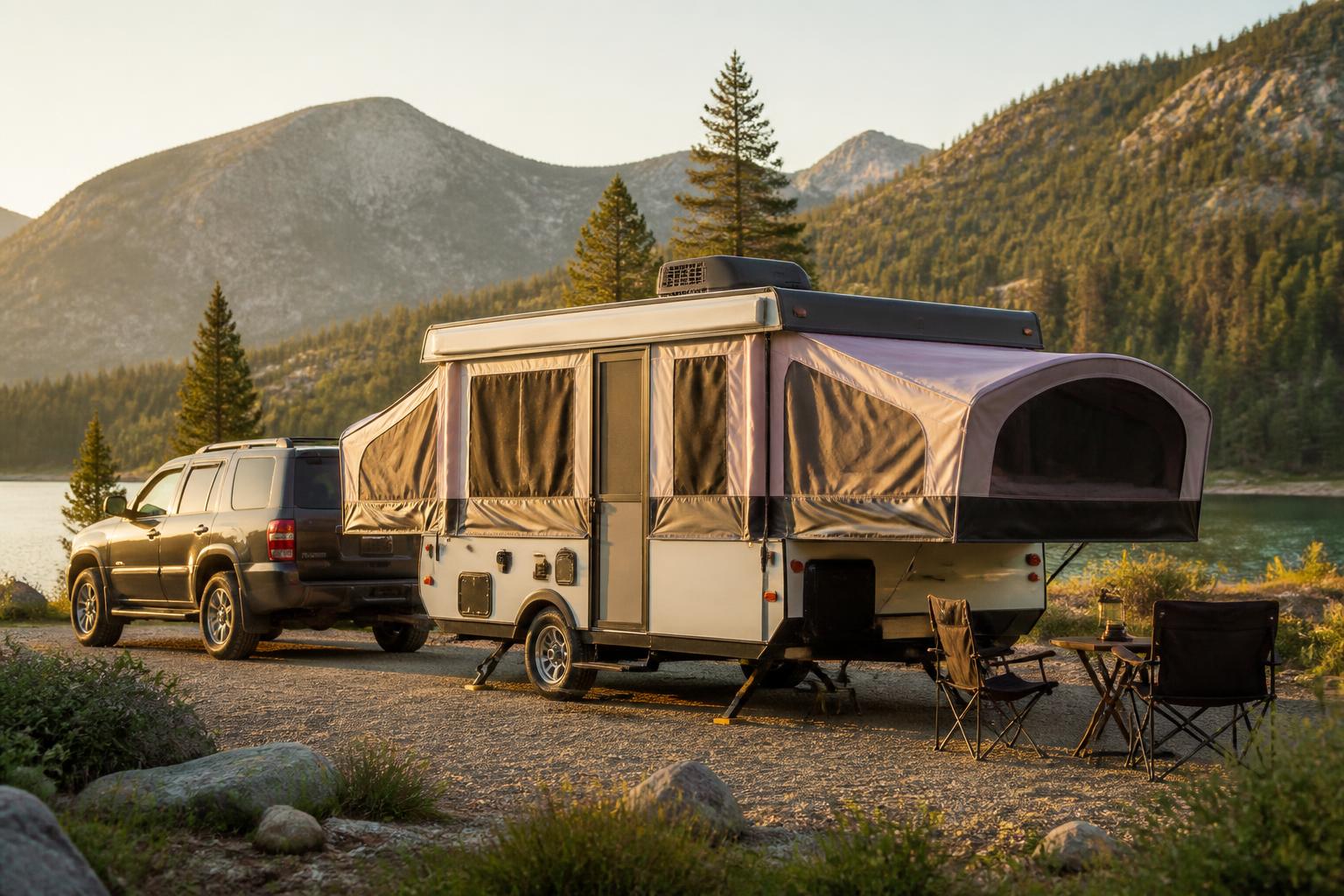
What is a pop-up camper?
The defining feature is a folding, tent-like structure mounted on a trailer frame. When collapsed, the unit sits 4 to 5 feet tall, making it easy to store in a garage and tow with a mid-size SUV or even some crossovers. Typical closed box lengths range from 8 to 16 feet, and dry weights run from about 1,000 to 3,500 pounds. Sleeping capacity varies from 4 to 8 people, spread across two to four slide-out beds.
Because the walls are canvas (or vinyl-coated fabric), pop-ups are lighter and cheaper than hard-sided travel trailers of similar size, but they offer less insulation and require manual setup each time you camp. Most models include a small propane stove, a sink, a 3-way refrigerator (12V/120V/propane), and a portable or cassette toilet. Air conditioning is often optional, not standard.
Tow vehicle requirements vary widely: a lightweight 8-foot model may need only a 2,000-pound towing capacity, while a fully loaded 16-foot model with a slide-out can exceed 3,500 pounds. Always compare the camper’s GVWR (Gross Vehicle Weight Rating, not dry weight) to your vehicle’s maximum towing capacity, and leave a 10–15% safety margin after adding gear, water, and propane. The applicability boundary here is critical: many midsize SUVs advertise 5,000-pound towing capacity, but that number assumes a single driver with no cargo.
Once you add passengers, gear, and the trailer’s tongue weight (typically 10–15% of total trailer weight), your actual safe capacity drops significantly. A Toyota Tacoma rated for 6,500 pounds may struggle to tow a 3,500-pound pop-up if the truck is loaded with four passengers and camping gear.
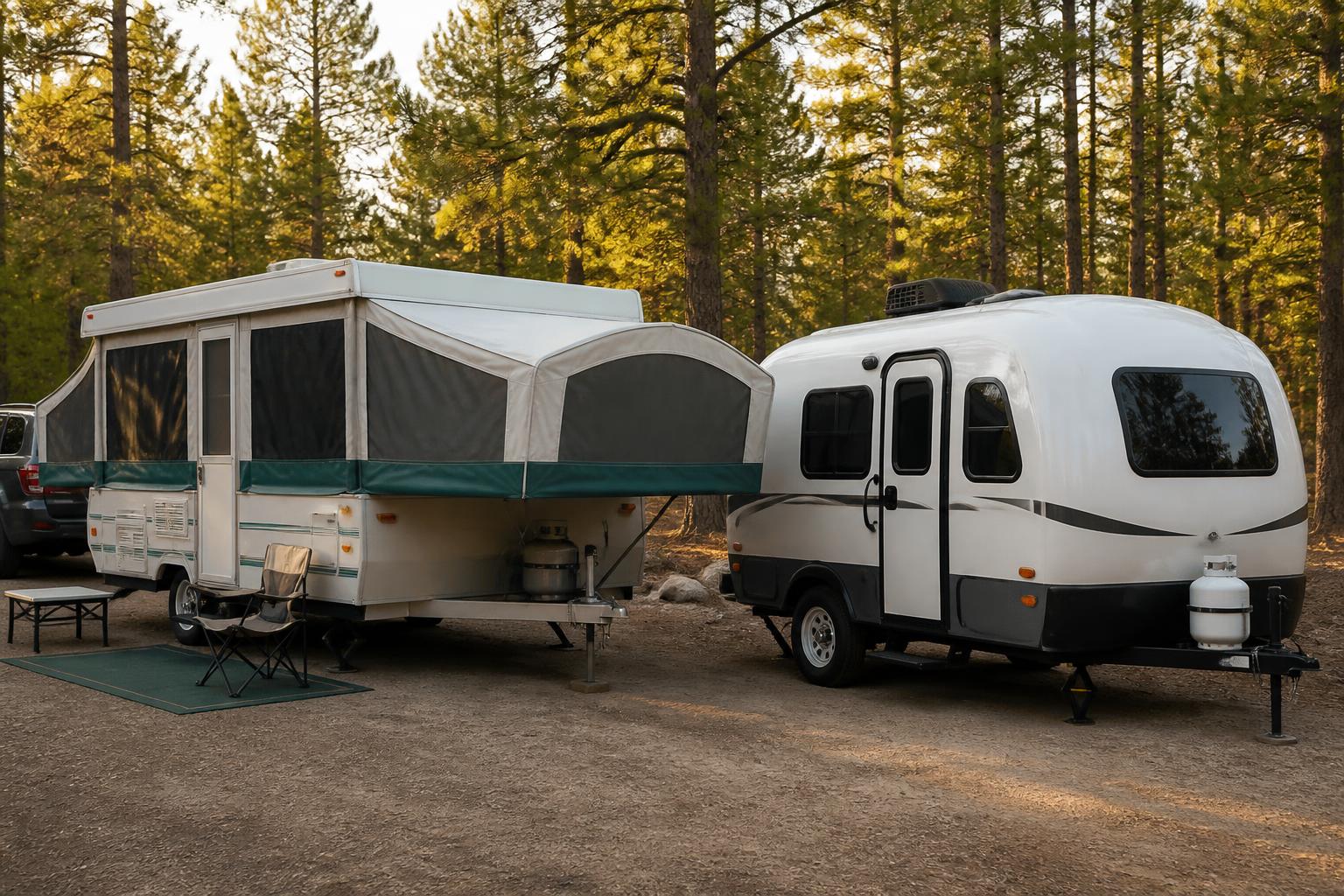
How does a pop-up camper compare to a small travel trailer?
The closest alternative is a small hard-sided travel trailer (often 12 to 20 feet). Here’s how they stack up:
| Factor | Pop-up camper | Small travel trailer |
|---|---|---|
| <strong>Towing weight</strong> | 1,000–3,500 lbs | 2,500–5,000 lbs |
| <strong>Setup time</strong> | 10–30 minutes (crank, unfold, stake canvas) | 5–10 minutes (level, unhitch) |
| <strong>Insulation / weather</strong> | Minimal; canvas leaks and drafts in wind/rain | Sealed walls, good for three-season or mild winter |
| <strong>Storage height</strong> | 4–5 ft (fits most garages) | 8–10 ft (needs outdoor storage or high garage) |
| <strong>Price (new)</strong> | $10,000–$25,000 | $18,000–$35,000 |
| <strong>Used price range</strong> | $3,000–$15,000 | $8,000–$20,000 |
| <strong>Canvas maintenance</strong> | Required (cleaning, water repellent, zipper care) | None |
When a pop-up is the better choice: If you have a mid-size SUV or pickup with modest towing capacity (under 5,000 lbs), limited storage, and a budget under $25,000. You’re also comfortable with a 15-minute setup and don’t plan to camp in sub-freezing weather.
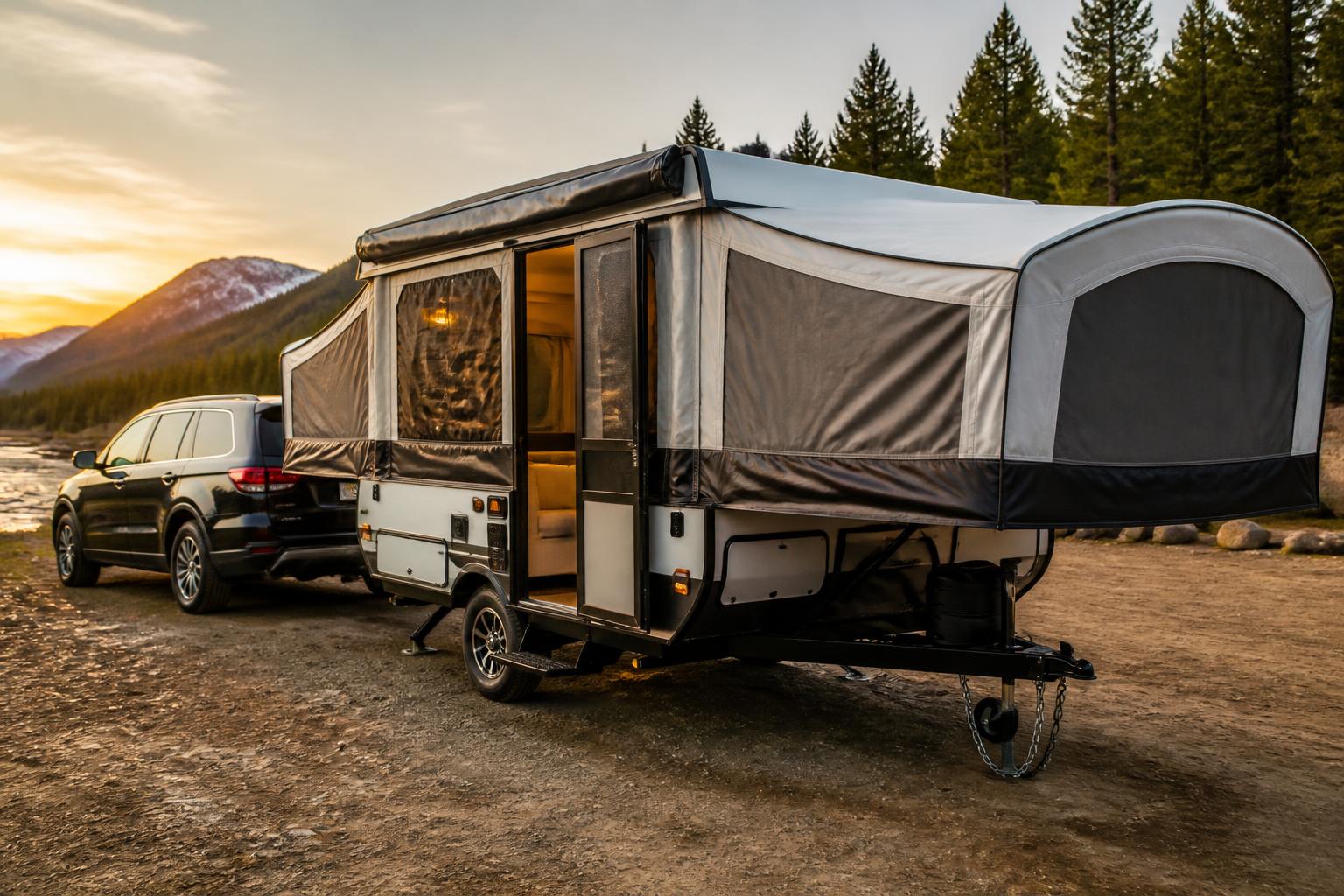
When a small travel trailer is better: If you want immediate shelter in rain, need heating or AC that works well in extreme temps, or you frequently camp in cold-weather zones. The mismatch most buyers miss: a small travel trailer still needs a stronger tow vehicle. A 3,000-pound travel trailer with a similar floor plan to a pop-up will require 4,000+ pounds of towing capacity after loading—many compact SUVs can’t handle that. So if you’re already at your tow limit, a pop-up may be your only practical option regardless of preferences.
Which pop-up camper fits your situation?
The single most important decision-changing factor is your tow vehicle’s capacity and your storage space. These two constraints narrow the market dramatically. The practical implication is straightforward: if you ignore these limits, you’ll either buy a camper you can’t safely tow or one that won’t fit in your garage, which means paying $50–$150/month for storage.
Towing capacity narrows your options first
- If you drive a compact SUV or sedan (towing ≤ 2,500 lbs): You need an ultra-light pop-up like a Forest River Rockwood FreeStyle (dry weight ~1,200 lbs) or a used Coachmen Clipper. These sleep 4–6 and have basic amenities. Skip any model with a slide-out or built-in toilet—they add 500+ pounds. The mismatch to watch for: many compact SUV tow ratings assume a single occupant. With passengers and gear, your usable capacity may drop 15–25%.
- If you have a mid-size SUV or half-ton pickup (towing 3,500–5,000 lbs): You can comfortably tow most 12–16 foot pop-ups, including those with a pop-up slide-out (which expands interior width). Models like the Jayco Jay Series 1208 or Flagstaff MAC 228D offer full kitchens, larger refrigerators, and room for 6–8. You still need to check the payload on your hitch receiver—tongue weight of 300–500 lbs is common.
Storage space narrows it further
- If storage height is limited (garage door < 5 ft): Many pop-ups fold to 4.5 ft, but check the specific closed height. A few high-wall models (like the Aliner family of hard-sided pop-ups) fold to 5.5 ft, which won't fit a standard garage. If you can't store inside, factor in outdoor storage costs ($50–$150/month) or a moisture-absorbing cover.
- If you camp in hot or humid climates: Canvas tends to grow mold if packed wet. Look for models with vinyl-coated walls (easier to wipe dry) and a “no canvas” hybrid like the Aliner, which uses rigid panels that fold. Otherwise, plan to air-dry the camper after each trip before closing—this adds 1–2 hours to your pack-up routine.
How to verify fit on your actual vehicle
Don’t trust the dealership’s “you’ll be fine.” Here’s how to confirm safely:
1. Find your vehicle’s GVWR and GCWR on the driver’s door jamb sticker—not the brochure. Your owner’s manual will list maximum towing capacity, but the GCWR (Gross Combined Weight Rating) is the more honest number: your fully loaded vehicle plus fully loaded trailer must stay under it.
2. Calculate real-world tongue weight: Multiply the camper’s GVWR by 0.10 to 0.15. A 3,500-pound camper means 350–525 pounds on your hitch. That eats into your payload capacity (sticker on door jamb). If your payload is 1,200 pounds and you have four 180-pound passengers (720 lbs), you’ve only got 480 pounds left for tongue weight plus gear in the truck bed.
3. Check your hitch receiver class (stamped on the side): Class II hitches max out at 3,500 pounds; Class III handles 5,000–8,000 pounds. A Class I hitch (2,000 pounds) will be dangerous with any pop-up over a lightweight 8-footer.
Five quick checks before you buy
These pass/fail checks will save you from buying the wrong camper. The first two checks should happen before you even visit a dealer—they determine which campers are possible.
1. Tow capacity margin – Compare the camper’s GVWR (not dry weight) to your vehicle’s maximum towing capacity. Add 300–500 lbs for gear, 40–60 lbs for propane, and 200–400 lbs for water if the tank is full. Pass if GVWR + gear is ≤ 80% of your vehicle’s capacity. Fail if you exceed that—you’ll risk transmission overheating, braking issues, or a citation if weighed at a DOT checkpoint.
2. Garage clearance – Measure the height of your storage area (garage door opening, then interior ceiling). Most pop-ups need 4.5–5.0 ft closed. Pass if you have at least 6 inches of clearance above the camper. Fail if the camper barely fits or you have to deflate tires—tire pressure reductions increase blowout risk on the road.
3. Setup speed test – Ask the seller or dealer to demonstrate a full setup, including leveling, cranking, pulling out the beds, and attaching the tent ends. Time it. Pass if you can complete it in under 15 minutes without frustration. Fail if it takes 25+ minutes or the crank mechanism feels stuck—replacement lift systems cost $300–$800.
4. Canvas condition (used models) – Inspect every inch of the canvas for tears, sun rot, and mildew spots. Open all zippers fully and check for smooth operation. Pass if the canvas is intact, zippers glide easily, and there’s no musty smell. Fail if you see any tears larger than 1 inch or mold inside the folds—replacement canvas costs $1,000–$3,000 and requires hours of labor to install.
5. Brakes and tires – Most states require trailer brakes on campers over 1,500 lbs. Check that the brake controller in your tow vehicle is compatible (7-pin connector needed for electric brakes). Look at tire date codes (DOT stamp on sidewall) – if older than 6 years, plan on replacing them ($200–$400). Pass if brakes function when you test and tires are under 5 years old. Fail if brakes are missing or tires are cracked—this is an immediate safety issue, not a negotiable.
New vs. used: realistic costs
New pop-up campers start around $10,000 for a basic 8-foot model with a manual crank (e.g., Jayco Jay Series 1006) and climb to $25,000–$30,000 for a 16-footer with power lift, slide-out, A/C, and a hot water heater. Mid-range options from Forest River, Rockwood, and Coachmen usually run $14,000–$22,000.
Used pop-up campers are a strong value if you’re handy. A well-maintained 10-year-old model could be $4,000–$8,000; a 5-year-old model $8,000–$14,000. Watch for canvas rot, broken crank gears, and water damage in the plywood floor (check the corners where the canvas meets the frame). Replacing a canvas is common on older units; factor that into your negotiating price. A realistic mismatch: a used camper with damaged canvas might look cheap at $3,000, but after $2,000 in canvas replacement and $400 for new tires, you’re at $5,400 for a camper that may also need new lift cables and a battery—suddenly not a bargain.
Ongoing ownership costs:
- Insurance: $150–$400/year for liability and comprehensive.
- Storage (if not in garage): $50–$150/month.
- Tires: replace every 6–8 years at $200–$400.
- Canvas treatment (water repellent spray): $20–$40 per season.
- Battery replacement (deep-cycle 12V): $100–$200 every 3–5 years.
- Annual bearing repack: $50–$100 if you DIY, $150–$250 at a shop.
Common complaints and how to avoid them
Canvas leaks – The most frequent issue. Even new canvas can leak at seams or around zippers. Fix: Apply a sealant made for outdoor fabric (like McNett Seam Grip or a silicone spray). Always store the camper completely dry. If you camp in heavy rain, use a rain fly or a small tarp over the roof section. The failure mode most owners miss: leaks often occur not at the canvas itself but at the vinyl-to-canvas seams where the bed slides attach. Test these seams with a garden hose before buying a used unit.
Setup difficulty – Older campers with manual crank lifts can be strenuous, especially if the mechanism is rusty or misaligned. Avoid: Test the lift in person before buying. Look for models with a power lift motor (optional on many newer units—adds $800–$1,500). Also, practice setup at home before your first trip. Escalation signal: if the crank requires more than moderate force to turn at any point, the lift cables may be frayed or the mechanism needs lubrication. Stop cranking, inspect the cables, and don’t buy the unit without a professional inspection.
Poor insulation – Canvas pop-ups are essentially tents—they get cold below 40°F and hot above 85°F. Workaround: Use a portable electric heater (if you have shore power) or a propane catalytic heater, but be aware that canvas walls don’t hold heat. For winter camping, look at hard-sided pop-ups (Aliner, Trail Manor) or skip pop-ups entirely. Concrete winter boundary: most manufacturers recommend storing pop-ups when temperatures drop below 20°F to prevent canvas cracking. If you camp in winter, this is the wrong RV type.
Limited storage – Most pop-ups have tiny cabinets and no separate bathroom. Solution: Pack light and use collapsible bins. Consider a model with a built-in cassette toilet and outdoor shower if you need more amenities. The trade-off many skip: each additional amenity adds 100–300 pounds and increases setup complexity. A pop-up with a slide-out, power lift, toilet, and AC can approach 3,500 pounds—requiring a full-size SUV and negating the weight advantage that attracted you to a pop-up in the first place.
Towing stability – Because pop-ups are tall when opened but have a relatively narrow wheelbase, crosswinds can cause sway. Reduce: Use a weight-distribution hitch with a sway control bar for any camper over 2,500 lbs. Keep speed under 65 mph. Stop signal: if the trailer starts swaying at any speed, do not try to correct with steering—gently reduce speed with the brakes while keeping the wheel straight. Sway that doesn’t stop below 55 mph means you’re over capacity or the hitch setup is wrong.
Who should actually buy a pop-up camper?
A pop-up camper is an excellent choice if:
- You have a tow vehicle with at least 2,000 pounds of capacity, ideally more, and you’ve verified your real-world towing limits.
- You can store the folded camper in a garage or secure shed—outdoor storage adds $600–$1,800/year.
- You camp primarily in mild weather (spring through fall) and are willing to spend 10–15 minutes setting up camp.
- You want to keep total RV investment under $25,000, including towing accessories.
A pop-up camper is probably not right if:
- You need instant shelter in rain or frequent cold-weather camping

Practical RV guides from an experienced owner. Motorhomes, travel trailers, truck campers — we have owned them, maintained them, and written the guides we wish we had found when we started.