RV Storage: What to Look For & Top Picks
Choosing where to store your RV comes down to three variables: your rig’s size, your local climate, and how often you actually use it. No single option works for everyone — and the conventional advice to “just put it indoors” often costs significantly more than the protection provides. This guide compares the major storage options with real-world costs, honest trade-offs, and a decision aid you can apply right now.
Indoor vs. Outdoor Storage: What Actually Matters
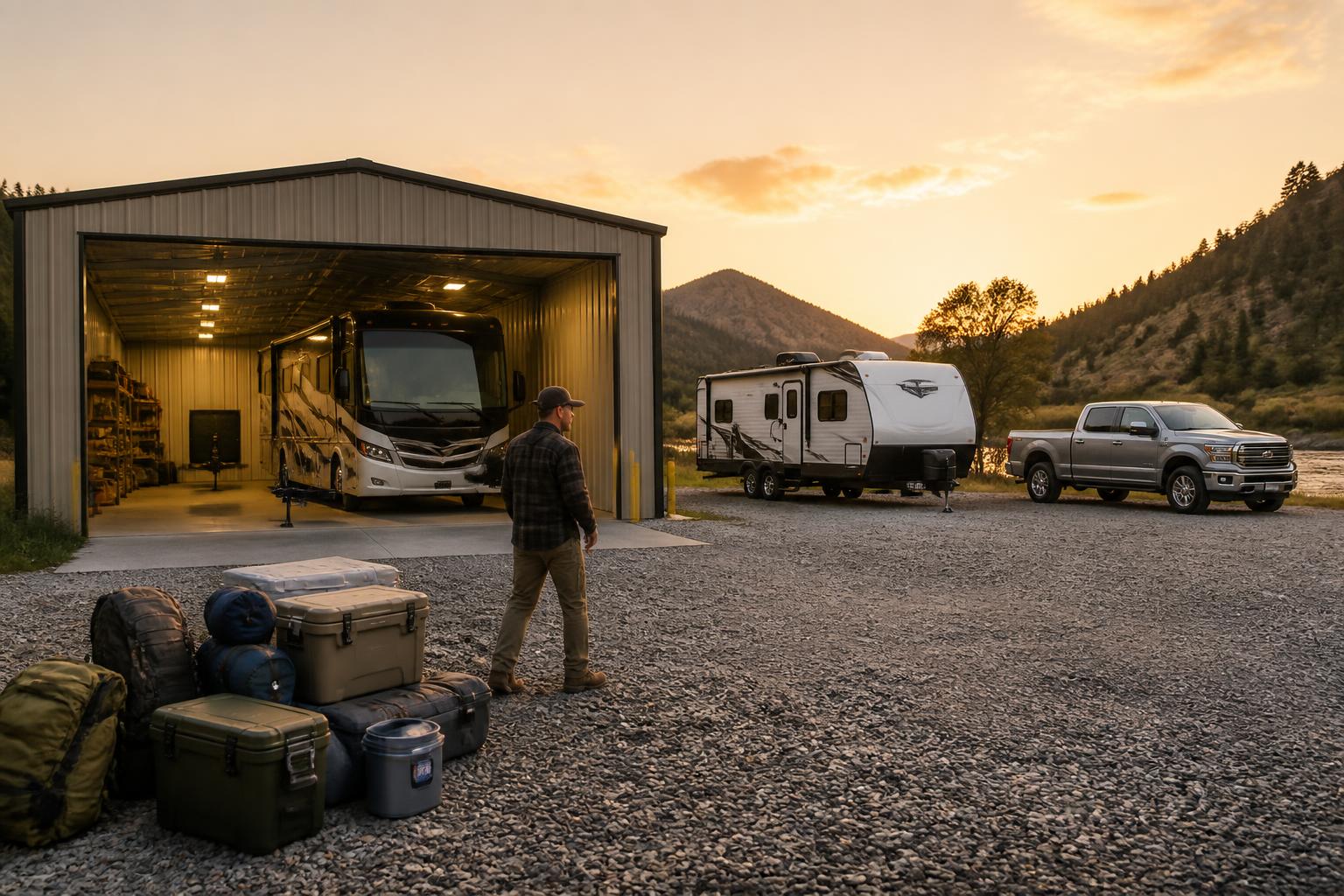
The biggest cost split in RV storage is between indoor (fully enclosed) and outdoor (uncovered or covered). The price difference is typically 2–3 times, but the protection gap isn’t always as wide as the price tag suggests.
Indoor Storage
Monthly rates for a 30–40 foot RV range from $200 to $400 in most metro areas. Climate-controlled units cost more, but many “indoor” facilities are just open-bay pole barns — they keep off rain and snow but don’t regulate temperature or humidity. If you’re storing a newer RV with sensitive electronics, a non-climate-controlled barn still protects against UV cracking and hail, but it won’t stop condensation or pest intrusion. Look for facilities that specify “climate control” in writing, and always visit the unit at midday to check ventilation.
Outdoor Uncovered
The cheapest option — $50 to $150 per month for the same size — but exposes your RV to everything: sun, hail, tree sap, and falling branches. UV damage is cumulative; even with a cover, sealant and roof life shorten by about 2–3 years compared to indoor storage. If you plan to keep the RV for 10+ years, outdoor uncovered may cost more in repairs than the monthly savings.
Outdoor Covered
A solid roof with open sides costs about $100–$200 per month. It blocks direct sun and heavy precipitation but still leaves the RV exposed to wind-driven rain, birds, and pests. For owners in mild climates (e.g., Pacific Northwest, coastal California) who use the RV every month, covered storage often provides the best balance of protection and price.
A Decision Criterion That Changes the Recommendation
If you live in an area that gets more than 30 inches of snow annually or regularly experiences UV indexes above 8, indoor storage becomes nearly mandatory for any RV over five years old. In those conditions, the additional repair costs from outdoor storage will exceed the monthly premium within two years. Conversely, in a dry, temperate climate (e.g., Southern Arizona, Nevada) where you take the RV out every three weeks, a covered spot is usually sufficient, and indoor storage is a luxury you can skip.
Applicability boundary: The recommendations above assume your RV has a standard roof material (TPO, EPDM, or fiberglass) and factory sealants. If your RV has a rubber roof older than five years or you’ve applied a DIY coating like Liquid Roof or elastomeric paint, outdoor storage is riskier regardless of climate. Rubber roofs degrade faster under UV even when covered, and DIY coatings can trap moisture. For these RVs, indoor storage is the only option that reliably preserves the roof. If you’re unsure of your roof type, check the manufacturer’s label inside a cabinet or near the entry door — it will list the roof material and the date of manufacture.
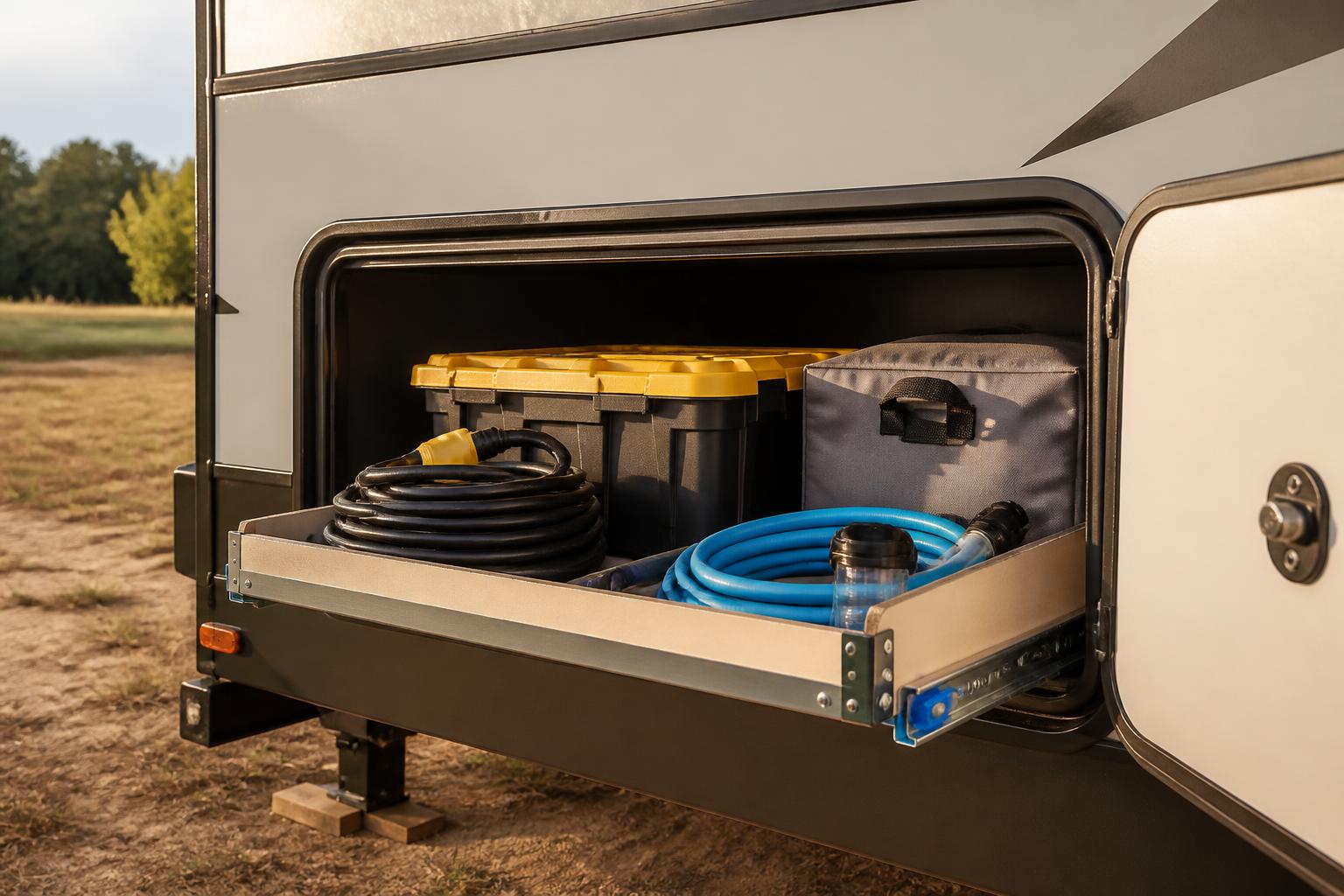
Practical implication for your next move: If you’re currently storing a rubber-roof RV outdoors in a snow or high-UV zone, budget for a roof replacement within 18–24 months, or move to indoor storage and extend that timeline to 5–7 years. The monthly savings from outdoor storage will be erased by a $1,500–$3,000 roof repair. Owners with TPO or fiberglass roofs in mild climates can safely use covered storage and still hit the 8–10 year sealant replacement interval.
At-Home Storage vs. Commercial Facility
Storing on your own property sounds free — and it can be, if you own the land and local rules allow it. But “park it at home” fails more often than guides admit.
At-Home Limits
Most suburban HOAs and many city ordinances forbid parking an RV in the driveway or street for more than 24–48 hours. Even where it’s legal, neighbors may complain, and a 35-foot fifth wheel often blocks sight lines. The practical maximum for at-home storage is a 24-foot Class B or small travel trailer, provided your lot has side access and no HOA covenant. For anything larger, you’ll need a commercial facility or a rural property with a dedicated RV garage.
Commercial Facility Trade-Offs
Monthly fees are the obvious downside, but many facilities include amenities that reduce your hassle: on-site dump stations (save you $15–$30 per trip), electrical hookups for battery maintenance, wash bays, and gated access with 24/7 camera coverage. Some also offer winterization services for $150–$300. Over a five-year ownership period, paying $100/month for outdoor commercial storage plus $150/year for winterization adds up to about $6,750. That’s less than the cost of a new roof and paint job after five years of uncovered at-home parking in a sunny climate.
When the Common Recommendation Fails
“Store it at home to save money” is the most repeated piece of RV storage advice, but it assumes you have no HOA, no street-parking restrictions, and a neighbor who won’t call code enforcement. If you lack those conditions, at-home storage becomes a fine risk rather than a savings. A single citation can cost $100–$500, and a neighbor dispute can escalate to towing. In dense suburban areas, a commercial facility is often the cheaper long-term option once you factor in your time and legal exposure.
A concrete verification step for at-home legality: Before deciding to store at home, call your city’s zoning or code enforcement office and ask two specific questions: (1) “What is the maximum number of consecutive hours a recreational vehicle can be parked on a driveway or street without a permit?” and (2) “Is there a size limit based on overall length or height?” Get names and dates for every call. Some cities enforce a 7-foot height limit for driveway parking, which eliminates any RV with rooftop AC units. Also check your HOA covenants — the document that governs your neighborhood — for a specific “no RV parking” clause. If the HOA says no, it’s a binding restriction regardless of city law.
A Quick-Fit Decision Aid for Your Storage Choice
Work through these six checkpoints before signing any contract. Each is a pass/fail test for your situation.
- Can you park on your property without HOA or zoning restrictions? Pass → at-home possible (if RV fits). Fail → commercial facility required.
- Is your RV shorter than 30 feet overall? Pass → more storage options available. Fail → indoor facility door heights matter; verify clearance.
- Do you live in a region with snow or extreme UV for more than 3 months a year? Pass → indoor or covered strongly recommended. Fail → outdoor uncovered is acceptable.
- Will you use the RV more than once every 30 days? Pass → access flexibility (24-hour gate) and electrical hookups are worth paying for. Fail → you can tolerate restricted access.
- Is your budget under $100 per month for storage? Pass → outdoor uncovered or at-home. Fail → you can consider covered or indoor.
- Does the facility offer a 30-day month-to-month lease with no early-termination fee? Pass → low commitment risk. Fail → negotiate or look elsewhere; lock-in penalties are common.
If you hit more than two fails, you’ll need to compromise on either cost or protection. For example, a 36-foot Class A owner in Michigan (snow zone, budget under $100, uses RV twice a year) will probably choose outdoor uncovered and accept the added maintenance. That’s a legitimate trade-off — just plan for it.
A realistic mismatch example: The budget check often clashes with the climate check. A 38-foot fifth wheel in Buffalo, NY needs indoor storage (snow zone, UV index moderate), but indoor rates run $250–$400. The owner’s budget is $100. In this case, the practical choice is outdoor uncovered with a heavy-duty RV cover ($200–$400 one-time) and a plan to reseal the roof every two years instead of the usual four. That’s a compromise that accepts 3–4 years off the roof life rather than the steeper monthly cost. The trade-off is real and concrete — do not choose uncovered storage here if your RV has a rubber roof older than five years.
How to Evaluate a Storage Facility: A Step-by-Step Inspection
Before you hand over a deposit, run this physical inspection. It takes about 30 minutes and can save you from a tow fee or a damaged RV.
Preparation: Bring a tape measure, a flashlight, and the RV’s specs (overall length, height including AC units, width with slides retracted). Check your insurance policy to see if it covers the vehicle while in storage — some require an added rider for facilities.
Step 1 — Check security basics on arrival.
Is the perimeter fence at least 6 feet high? Are there visible cameras covering the gate and all aisles? Is the gate code or keypad system working? (Ask to see it operate.) Is there an on-site manager during business hours?
Step 2 — Measure the door opening and the aisle.
For an indoor unit, the door must be at least 2 feet wider and 1 foot taller than your RV. A 14-foot-wide door is standard for 40-foot rigs, but some older facilities top out at 12 feet. The turning radius inside the aisle must allow a full exit without a three-point turn. Mark a 25-foot radius on the pavement with chalk and test with a car first if you’re unsure.
Step 3 — Inspect the ground surface.
Asphalt or concrete: ideal, especially if sealed. Gravel: acceptable if compacted, but soft spots can sink jacks and cause leveling issues. Mud: walk away — you’ll get stuck after rain.
Step 4 — Ask about access hours and rental terms.
Most facilities offer 7 a.m. to 8 p.m. access. If you need 24/7 access, confirm it’s not limited by a “gate hours” clause. Find out the late fee policy (common: $25 if you stay more than 15 minutes past closing). Some facilities charge a full day’s rent for overnight delay.
Likely causes of friction:
- Low clearance signs are missing or faded → you hit the header.
- The contract has a mandatory 12-month lock-in → you can’t leave if the facility raises rates.
- The manager insists the unit is “weathertight” but you see daylight through the roof seams → expect leaks.
Stop/success signal: The facility satisfies all four inspection steps, offers a month-to-month lease with 30-day notice, and the contract clearly lists all fees (rent, deposit, administration fee, late fee, gate damage charge). If you see any hidden fee line labeled “administrative maintenance fee” without a definition, cross the facility off your list.
What to do when you spot a clear mismatch: If the facility passes Step 3 and Step 4 but fails on security (no cameras, no perimeter fence), you have a decision to make. For a $10,000 pop-up camper, the risk may be acceptable. For an $80,000 fifth wheel with a generator and solar panels, it’s not. Similarly, if the facility has a 12-month lock-in but a lower rate, calculate the penalty for breaking the lease early (often two months’ rent). If you plan to sell the RV within the year, take the month-to-month option even at a slightly higher rate. The early-termination cost typically wipes out any per-month savings.
Cost Realities and Hidden Fees
Average monthly RV storage costs vary widely by region and facility type. The following are typical ranges based on industry reports for a 30-foot trailer or Class C:
| Storage Type | National Monthly Range | In Boise, ID | Nationwide 10×20 Unit (approx) |
|---|---|---|---|
| Outdoor uncovered | $50 – $150 | $60 – $120 | $80 – $130 |
| Outdoor covered | $100 – $200 | $120 – $180 | $120 – $180 |
| Indoor (climate-controlled) | $200 – $400 | $150 – $300 | $150 – $300 |
Note: Boise is given as an example because it’s a common PAA query. Costs in your city may differ. Always get three written quotes.
Hidden fees to watch for:
- Deposit: One month’s rent is standard, but some facilities charge a non-refundable “reservation fee” of $50–$100.
- Administration fee: $25–$75 per contract. Ask if it’s waived if you sign same day.
- Late fee: $20–$50 per day after a 5-day grace period.
- Insurance requirement: Many facilities require you to name them as an additional insured on your RV policy or buy their own for $10–$15/month.
A concrete way to verify the true monthly cost: When you get a written quote, take the total due for the first month (including deposit and admin fee) and divide by 12 to get the effective monthly cost for year one. For example: $250/month rent + $250 deposit + $75 admin fee = $575 due at signing. The effective cost for the first year is ($575 + $250 × 11) ÷ 12 = $277 per month. Compare that to a facility with $275/month rent, no deposit, and a $50 admin fee: ($325 due at signing, then $275 × 11 = $3,025 over the next eleven months, total $3,350, divided by 12 = $279 effective).
The second facility comes out slightly higher per month but avoids the up-front deposit. The real difference is that you won’t have to wait for a deposit refund (which some facilities delay by 30–60 days). Always ask about deposit refund timing.
Frequently Asked Questions
What’s the average cost of storing an RV?
Nationally, expect $50–$150 per month for outdoor uncovered, $100–$200 for outdoor covered, and $200–$400 for indoor climate-controlled storage for a 30-foot rig. Actual rates vary by city, facility amenities, and demand.
How much does it cost to store an RV in Boise?
In Boise, ID, outdoor uncovered runs about $60–$120 per month, covered $120–$180, and indoor $150–$300. Boise’s dry climate means covered storage is often sufficient for most RVs, but winter snow still makes indoor a better choice for rigs older than five years.
What’s the average cost of a 10×20 storage unit?
A standard 10×20 unit nationwide averages $80–$130 for outdoor, $120–$180 for covered, and $150–$300 for climate-controlled indoor. However, note that a 10×20 unit fits at most a 24-foot Class B or small travel trailer — a 30-foot fifth wheel will not fit. Always measure your RV’s length and height before assuming a 10×20 works.
Can you sleep in your self-storage?
Most commercial RV storage facilities do not allow sleeping in the vehicle on-site. Their leases typically prohibit overnight occupancy for liability and zoning reasons. A few rural facilities may permit it if you ask, but assume the answer is no. If you need a place to sleep while traveling, use a campground or RV park instead.

Practical RV guides from an experienced owner. Motorhomes, travel trailers, truck campers — we have owned them, maintained them, and written the guides we wish we had found when we started.